In the early months of World War I, the oceans became a battlefield just as dangerous as the trenches of Europe. Naval warfare was not only about strength, but also deception. Disguised ships, hidden guns, and surprise attacks became tools of survival and sometimes, of irony.
One such moment unfolded in 1914, involving a German commerce raider and a British passenger liner that shared the same name: Carmania.
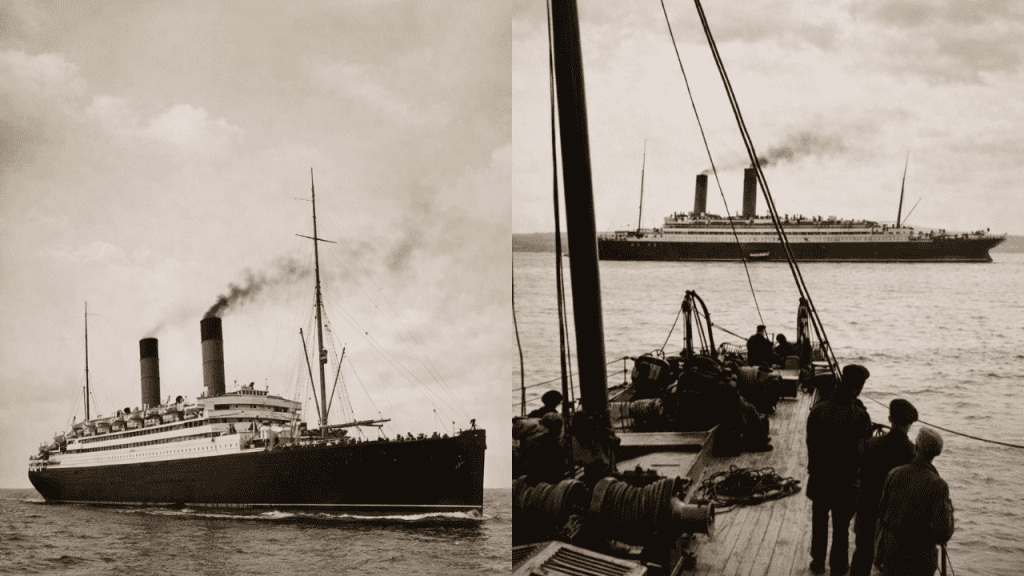
The German Navy had converted one of its ships into a disguised raider, giving it the appearance of the British RMS Carmania. The idea was clever. By mimicking a friendly vessel, the ship could approach unsuspecting targets, then reveal its weapons and strike without warning. In the vastness of the Atlantic, where identification could mean the difference between safety and destruction, such tactics were both effective and feared.
But war does not always follow plans.
In a twist that seems almost unbelievable, the disguised German ship actually the SMS Cap Trafalgar encountered the real RMS Carmania. The British vessel, however, was no ordinary passenger liner at that moment. Like many civilian ships during the war, it had been converted into an armed merchant cruiser, fitted with guns and ready for combat.
What followed was a battle shaped as much by confusion as by firepower.
At first glance, the ships mirrored each other similar silhouettes, similar structures two near-identical figures facing off in open water. But once the guns opened fire, the illusion shattered. The engagement quickly turned into a fierce naval duel, with both sides exchanging heavy fire across the sea.
Smoke poured from funnels, shells tore into steel, and the calm of the ocean gave way to violence.
Despite sustaining significant damage, the real Carmania managed to gain the upper hand. The disguised raider, caught in a situation no strategist could have planned, began to falter. Eventually, the SMS Cap Trafalgar was overwhelmed and sank beneath the waves.
The British ship survived, though battered and scarred.
The encounter became one of the most unusual naval battles of the war a moment where deception collided with reality in the most literal way. A ship disguised as its enemy had met the very vessel it was pretending to be.
It’s a story that endures not just because of its irony, but because it captures something deeper about war itself. Even the most carefully constructed plans can unravel in an instant. Chance, timing, and circumstance can reshape outcomes in ways no one expects.
Out on the open ocean, where identities could be masked and danger could appear without warning, one encounter proved that sometimes, the line between disguise and truth disappears entirely and when it does, only one side sails away.