
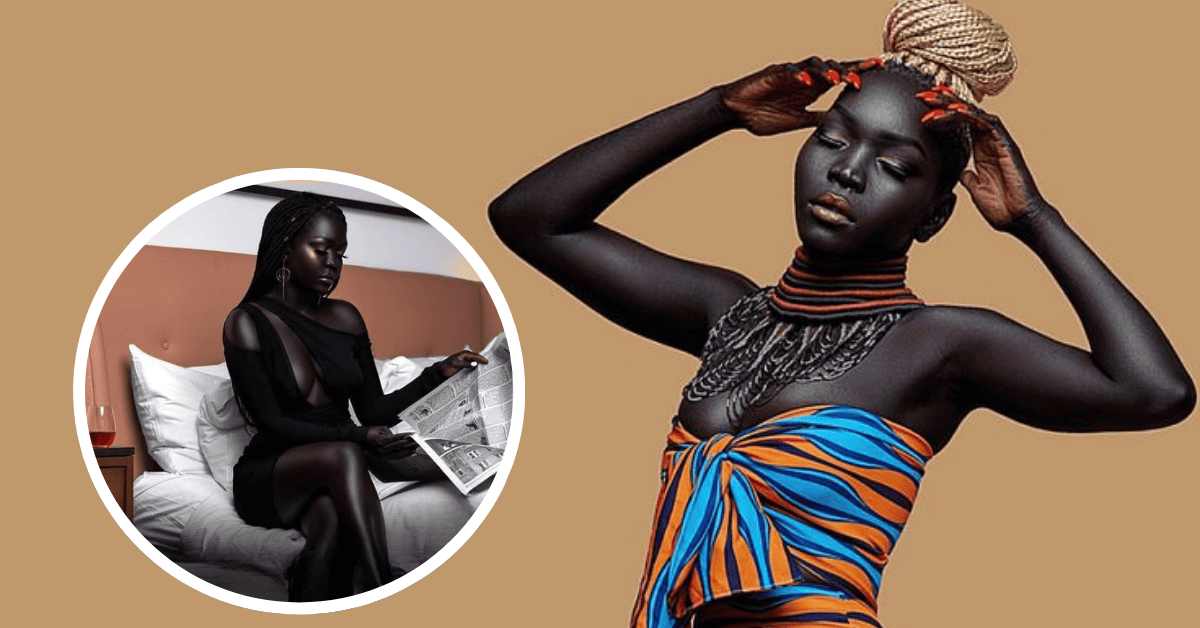
Born to South Sudanese parents and raised in the United States, Nyakim Gatwech grew up moving between two worlds—one shaped by her family’s heritage and another defined by the society around her. From an early age, she became acutely aware of how deeply colorism was woven into everyday life. Her exceptionally dark skin, instead of being celebrated, was often questioned, mocked, or treated as something unusual. Those experiences left lasting impressions, forcing her to confront painful ideas about beauty and worth long before she had the words to challenge them.
As a young girl, Nyakim struggled with the pressure to conform. Comments from peers and strangers alike suggested that her skin was something to fix, something that needed to be lighter in order to be acceptable. Even within communities of color, she encountered the belief that darker skin limited opportunity. For a time, those messages weighed heavily on her confidence. Yet beneath the doubt, a quiet resolve was forming. Nyakim began to understand that the problem was never her appearance, but the narrow standards being imposed on her.
That realization became a turning point. Instead of shrinking herself to fit expectations, Nyakim chose to stand taller. She entered the fashion world carrying both her scars and her pride, determined not to apologize for the body she was born into. When industry voices suggested she would be more “marketable” if she lightened her skin, she refused outright. Her response was firm and unwavering: her skin was not a flaw—it was a crown.
As her presence grew, so did her impact. Nicknamed the “Queen of the Dark,” Nyakim transformed what society once framed as a disadvantage into her defining strength. Her deep, radiant skin became a symbol of resistance against colorism and exclusion. Each photoshoot, runway appearance, and public statement reinforced a message that beauty does not exist within a single shade or standard.
Today, Nyakim uses her platform to advocate for self-love, representation, and diversity in an industry that has long marginalized people who look like her. She speaks openly about her experiences, not to dwell on pain, but to empower others who may be fighting similar battles. Through her visibility, she challenges long-standing norms and encourages people to question who beauty standards truly serve.
Nyakim’s journey is not just about modeling or fashion. It is about reclaiming identity and rewriting narratives that have excluded entire communities. Her story reminds the world that confidence begins with acceptance—and that true beauty emerges when people are allowed to exist fully, unapologetically, and without compromise.