
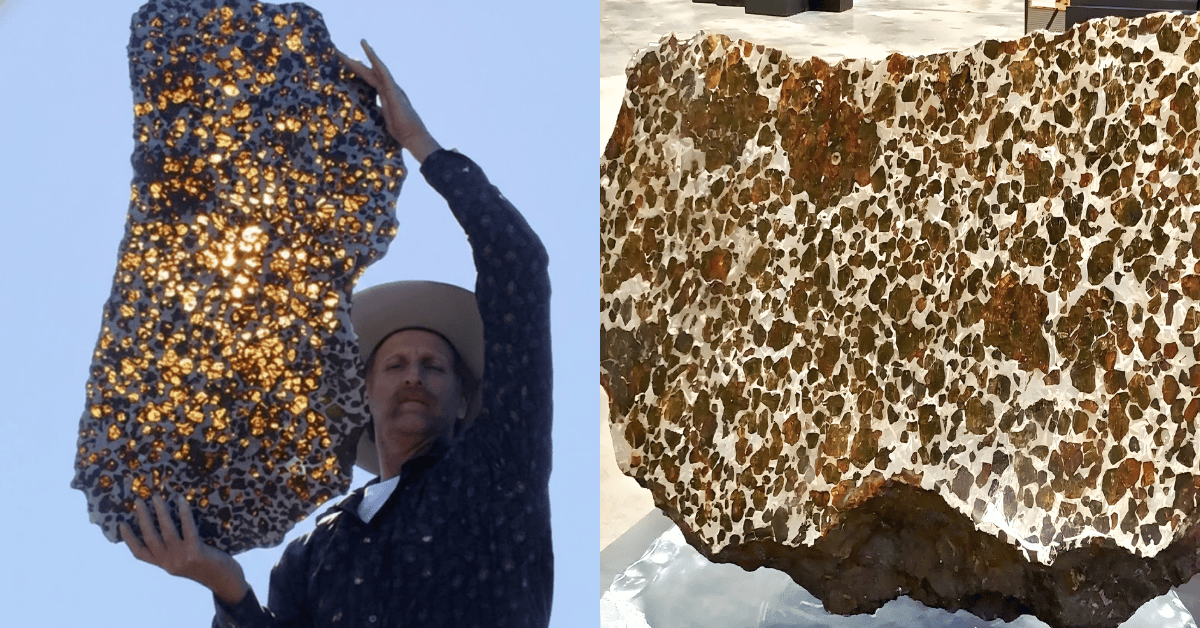
In the mountains near Fukang, in China’s remote Xinjiang region, a strange and beautiful relic from the dawn of the solar system was discovered in the year 2000. Scientists estimate that this meteorite, now simply called the Fukang meteorite, is roughly 4.5 billion years old—older than Earth itself, formed when the first dust and rock began clumping together to create planets.
At first glance, Fukang doesn’t look like anything remarkable. It is a heavy, irregularly shaped rock, dark and unassuming. But when cut open, it reveals something extraordinary: shimmering, translucent green crystals of olivine suspended in a metallic iron-nickel frame. The effect is almost otherworldly, as if someone had frozen fragments of emerald in molten metal. This rare structure places Fukang in a special class of meteorites called pallasites.
Most meteorites are simply fragments of rock or metal left over from collisions in space. Pallasites, however, are far more exceptional. They are believed to originate from the boundary between the core and mantle of early planetary bodies, a region of intense heat, pressure, and movement. In other words, Fukang is not just a chunk of space rock; it is a window into the very process of planetary formation—a piece of a world that existed before Earth itself was fully formed.
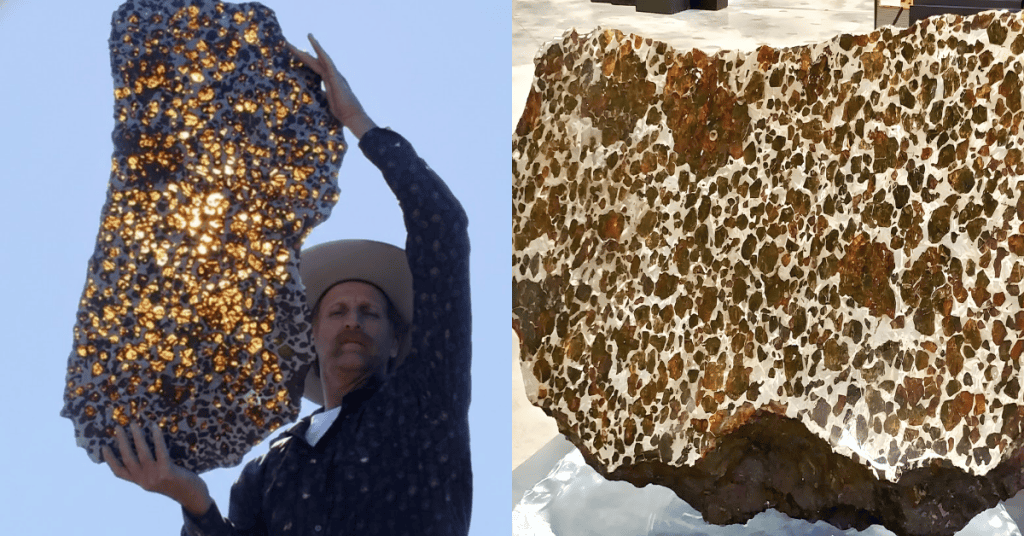
Fukang’s size adds to its wonder. Its original mass likely exceeded a thousand kilograms, making it one of the largest and most scientifically valuable pallasites ever discovered. It is not just beautiful; it is a record of cosmic history, written in metal and crystal. Scientists study it to understand how planets differentiate into core, mantle, and crust, and to glimpse the violent processes that shaped the early solar system.
For billions of years, this meteorite drifted through the emptiness of space. It survived collisions, endured the fiery passage through Earth’s atmosphere, and finally settled quietly in the mountains, hidden from human eyes. It waited patiently, unnoticed, long after the chaos that formed the planets had ended, until chance brought it to us.
Holding a piece of Fukang is unlike holding any other rock. It is a tangible connection to a time when worlds were still forming, when matter was colliding and combining to create planets, moons, and eventually life. It is a reminder that the universe has stories that predate humanity by billions of years, and that sometimes, the messages of the cosmos are not sent in light or sound but preserved quietly in stone.
The Fukang meteorite is more than a relic. It is a lesson in patience, persistence, and the beauty of natural processes on a scale we can scarcely imagine. It teaches us that the universe’s history is waiting all around us, often in forms that demand we look closely, carefully, and with wonder. Sometimes, the stars speak not through fire or light, but through stone, and all we have to do is learn to listen.