
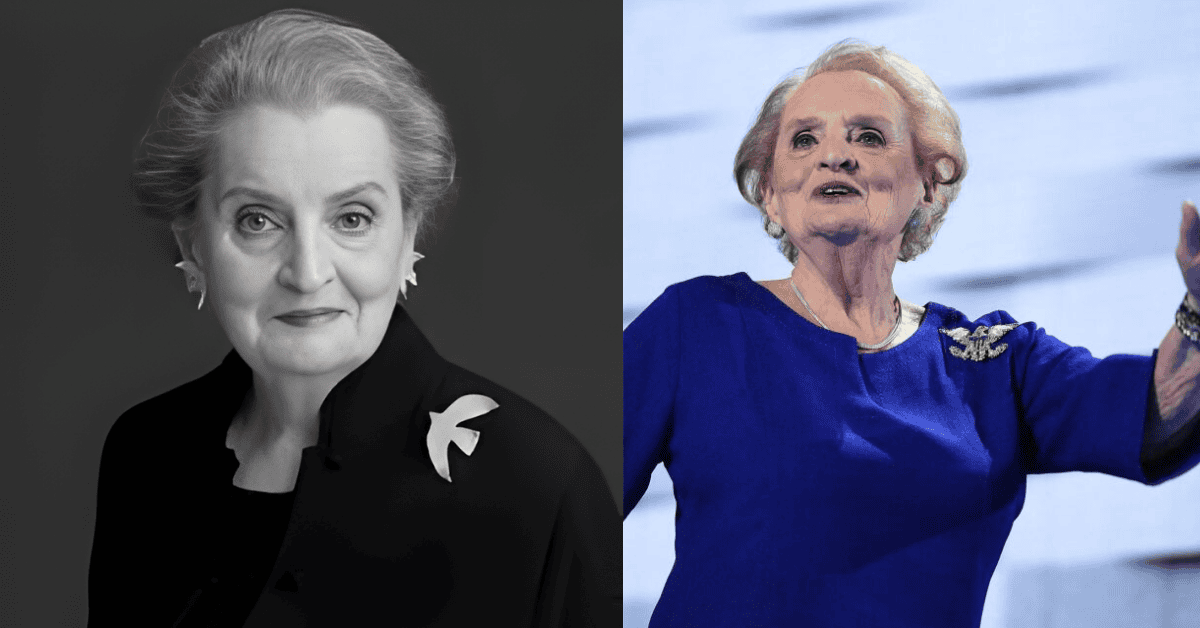
Madeleine Albright was born Marie Jana Korbelová in Prague in 1937. When Nazi Germany occupied Czechoslovakia in 1939, her family fled. She was just a child when they escaped to London. At the time, she did not fully understand what they were leaving behind.
Decades later, she learned that three of her grandparents had been murdered in the Holocaust.
After World War II, her family returned briefly to Czechoslovakia, only to flee again in 1948 when the Communists took power. This time, they immigrated to the United States. Albright grew up in Denver, eventually becoming a U.S. citizen and building an academic career focused on international relations.
She earned a PhD from Columbia University and later taught at Georgetown University. Her expertise in foreign policy and Eastern Europe positioned her for public service. In 1993, President Bill Clinton appointed her U.S. Ambassador to the United Nations.
In 1997, at age 59, Madeleine Albright became the first woman to serve as U.S. Secretary of State.
Her tenure came during a complex post–Cold War period. She was a strong advocate for NATO expansion, supporting the inclusion of former Eastern Bloc nations. She backed U.S. intervention in the Balkans during the Kosovo conflict, arguing that ethnic cleansing and mass violence required international response.
Albright was known for her strategic clarity and direct communication style. She believed American leadership mattered in maintaining global stability. She also emphasized democracy promotion and human rights as central pillars of U.S. foreign policy.
One of her most distinctive traits was her use of brooches. After being criticized by Saddam Hussein’s media as an “unparalleled serpent,” she wore a snake pin during meetings. She later said her jewelry became a form of diplomatic messaging subtle, symbolic, and intentional.
Beyond policy decisions, her legacy includes mentorship. She encouraged women to enter diplomacy and public service at a time when leadership positions were still overwhelmingly male. Her famous remark “There’s a special place in hell for women who don’t help each other” became widely quoted.
From a refugee twice displaced by authoritarian regimes to America’s top diplomat, her life reflected the 20th century’s upheavals.
Madeleine Albright did not just witness history.
She helped shape it.