
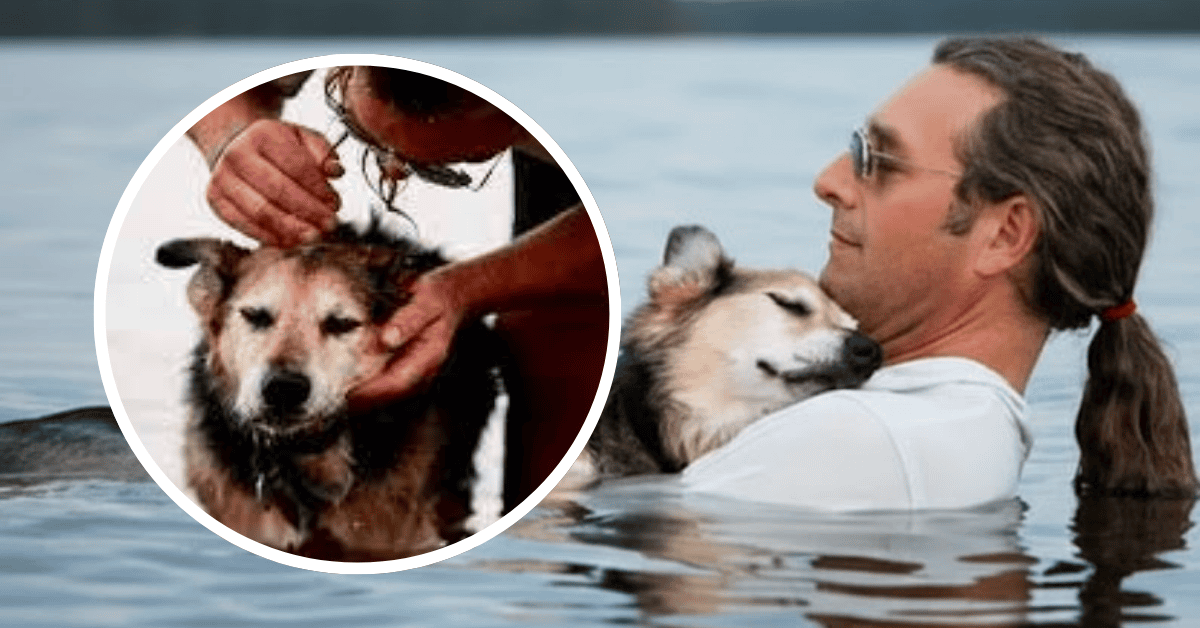
Some stories remind us that love isn’t always about fixing what’s broken- it’s about easing what can’t be cured. This is the story of John Unger and his dog, Schoep, and it shows what care can look like when medicine has run out of answers.
By the early 2010s, Schoep, an elderly German Shepherd, was struggling. Severe arthritis made every movement painful. Walking was agony. Standing caused sharp discomfort. Even lying down offered little relief. Veterinarians did what they could with medication, but Schoep’s mobility continued to decline. Like many pet owners facing this stage of life, Unger felt a growing helplessness. He wanted to do right by Schoep, but the usual treatments were no longer enough.
Then, in a quiet, ordinary moment, something extraordinary happened. Unger lifted Schoep into the shallow water of Lake Michigan. The buoyancy of the water took the weight off the dog’s aching joints. The cool temperature eased inflammation. For the first time in a long while, Schoep could relax. He unclenched his muscles, sometimes drifting into sleep while being held. What seemed like a simple act – holding his dog in water- was a small miracle of relief.
Unger repeated the routine every evening. No shortcuts, no desire for fame, no viral intentions- just patience, repetition, and quiet effort. The now-famous photograph of Schoep floating in Unger’s arms did not capture a performance or a staged moment. It captured routine care, the slow, loving work of reducing suffering in the time that remained.
What makes this story particularly moving is the clarity with which Unger faced reality. He understood that Schoep’s life was limited. This wasn’t about refusing to let go or trying to cheat death. It was about ensuring that the time left was gentle, comfortable, and full of small moments of peace. Life could not be fixed, but suffering could be eased.
Schoep ended up living longer than expected, but what mattered most was not the extra days—it was the quality of those days. Walking without agony, lying without tension, resting in water without pain. Those moments became a testament to love expressed through care, not control.
This story reminds us that love is often measured in the small, repeated acts that make life bearable, even when it can’t be changed. Sometimes the kindest thing we can do is not to cure, but to comfort. For Unger and Schoep, those quiet evenings in Lake Michigan showed that care, attention, and empathy can make all the difference. When nothing else can be fixed, sometimes the truest love is simply holding someone through the pain.