
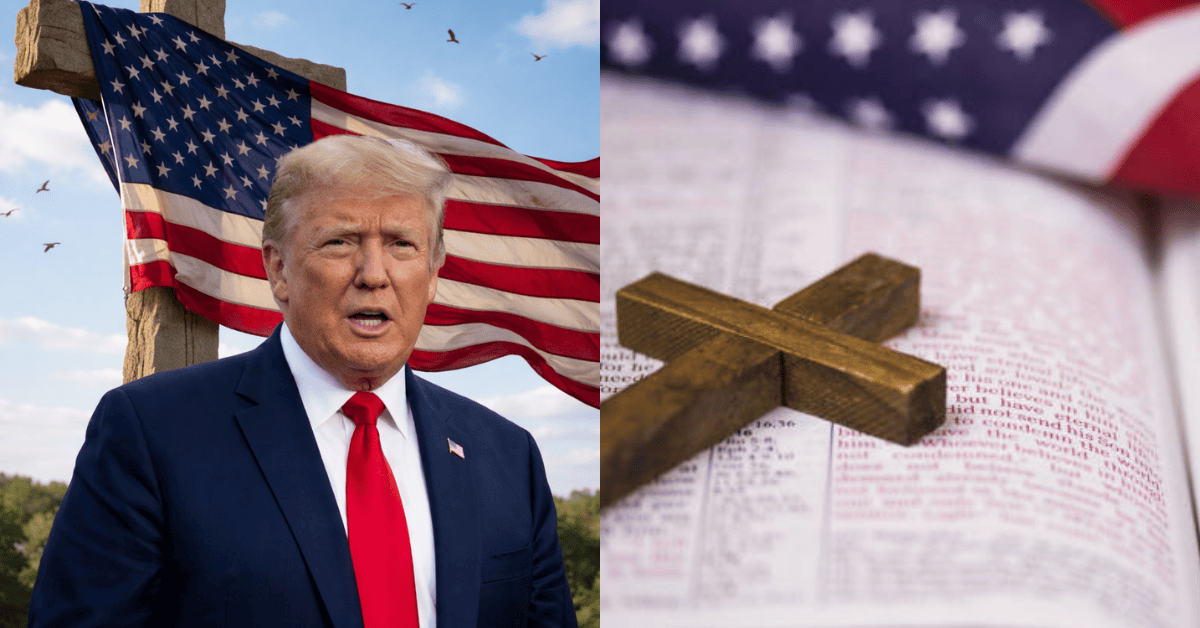
President Donald Trump has proposed the idea of establishing a nationwide day of spiritual reflection and unity, suggesting that Americans symbolically “rededicate the nation as one nation under God” on May 17, 2026. The concept, which he mentioned during public remarks, is framed as a moment for Americans to reflect on what he describes as the country’s moral and religious foundations.
According to Trump, the proposed day would encourage people across the United States to pause and consider the role that faith and shared values have played in the nation’s history. While the initiative is still in the early stages and specific plans have not yet been formally announced, supporters envision a variety of activities taking place throughout the country. These could include public gatherings, prayer services, community events, and participation from faith leaders representing a wide range of religious traditions and denominations.
Advocates of the proposal argue that faith has long been woven into the historical and cultural fabric of the United States. They often reference elements of American civic tradition that include religious language, such as the national motto “In God We Trust” and the phrase “one nation under God,” which appears in the Pledge of Allegiance. Supporters say the proposed day would not be about promoting any single religion, but rather about acknowledging the influence of faith and moral principles that many believe have shaped the nation’s development.
Some backers also say the timing of such an event could be meaningful. They point to the deep political, social, and cultural divisions currently present in American society and argue that a nationwide moment of reflection could provide an opportunity for people to step back from partisan conflicts. In their view, the day could serve as a unifying moment in which communities come together to reflect on shared values such as compassion, responsibility, and hope for the country’s future.
At the same time, the idea has sparked discussion and debate among legal scholars, political observers, and members of the public. Critics have raised concerns about the role of government in promoting religious expression, noting that the U.S. Constitution emphasizes the separation of church and state. Some argue that a federally promoted day centered on religious reflection could blur that boundary, even if participation were voluntary.
Others, however, note that similar national observances have existed in the past. The United States has long recognized a National Day of Prayer, and various presidents throughout history have issued proclamations encouraging citizens to reflect, pray, or give thanks during moments of national significance. Supporters of Trump’s proposal point to these precedents as evidence that symbolic religious acknowledgments have often been part of American civic life.
Political analysts also view the proposal within the broader context of Trump’s political messaging. Throughout his political career, Trump has frequently emphasized themes of faith, religious freedom, and traditional values, particularly when speaking to religious communities and voters. These themes have been a consistent part of his outreach strategy, especially among evangelical Christian groups and other faith-based constituencies.
As May 17, 2026 approaches, more details are expected to emerge regarding how the proposed day might be structured and whether it will move forward in an official capacity. Questions remain about whether it would involve a formal proclamation, congressional support, or simply serve as a symbolic call for voluntary participation.
Regardless of the outcome, the proposal has already generated conversation about the role of faith in public life and how Americans interpret the nation’s founding ideals. For some, the idea represents an opportunity for reflection and unity, while for others it raises important constitutional questions about the relationship between religion and government in the United States.