
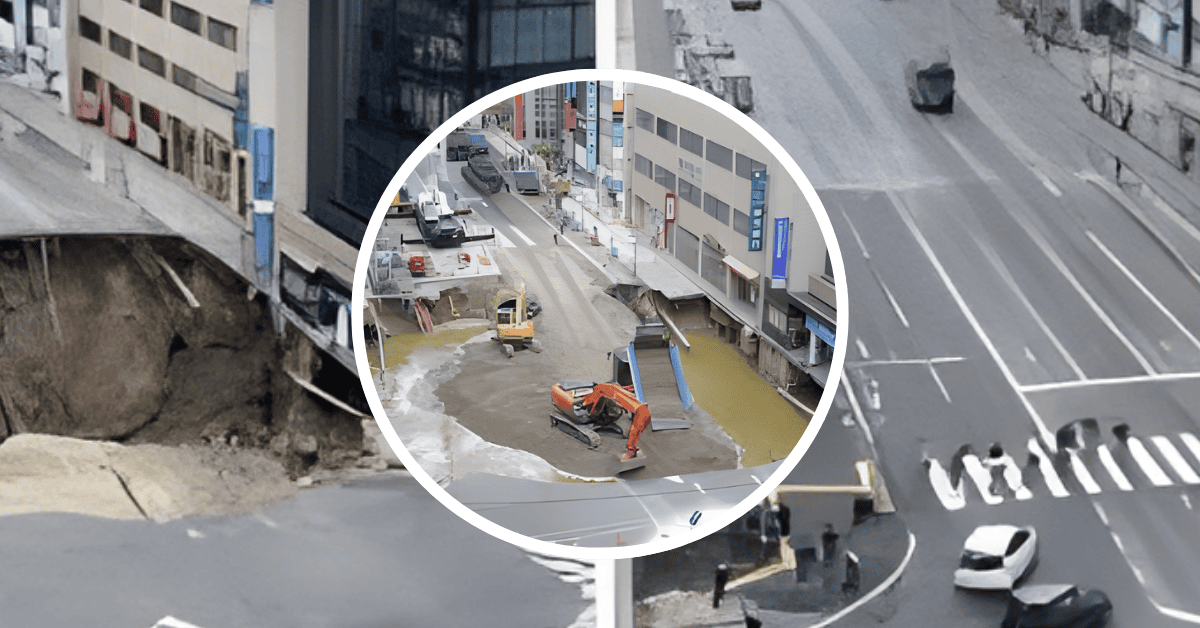
At 5:15 in the morning, a city street in Japan didn’t crack or sag or partially fail. It vanished. Where there had been pavement only minutes earlier, there was suddenly empty space.
In November 2016, a massive sinkhole opened near Hakata Station in Fukuoka, one of the busiest transportation hubs in the region. The collapse swallowed a major intersection and severed electricity, water, gas, and communication lines serving nearby buildings. The cavity measured roughly thirty meters across and plunged about fifteen meters deep, wide and deep enough to make the surrounding skyline feel unstable, as though the ground itself could no longer be trusted.
Photos and video spread around the world within hours. To most observers, the conclusion seemed obvious. Repairs on that scale would take months, possibly years. Roads would remain closed, businesses disrupted, and bureaucratic delays would stretch the recovery into a long, visible ordeal. The images fit a familiar narrative of modern infrastructure failing faster than it can be repaired.
That assumption turned out to be wrong.
Almost immediately, crews began working in continuous shifts. Engineers stabilized the surrounding soil and pumped the cavity full of rapid-hardening cement to prevent further collapse. The backfilling was done carefully and methodically, layer by layer, while sensors monitored ground movement in real time. At the same time, teams worked in parallel to restore seven critical utility lines—electricity, water, gas, sewage, and communications—rather than addressing them one after another.
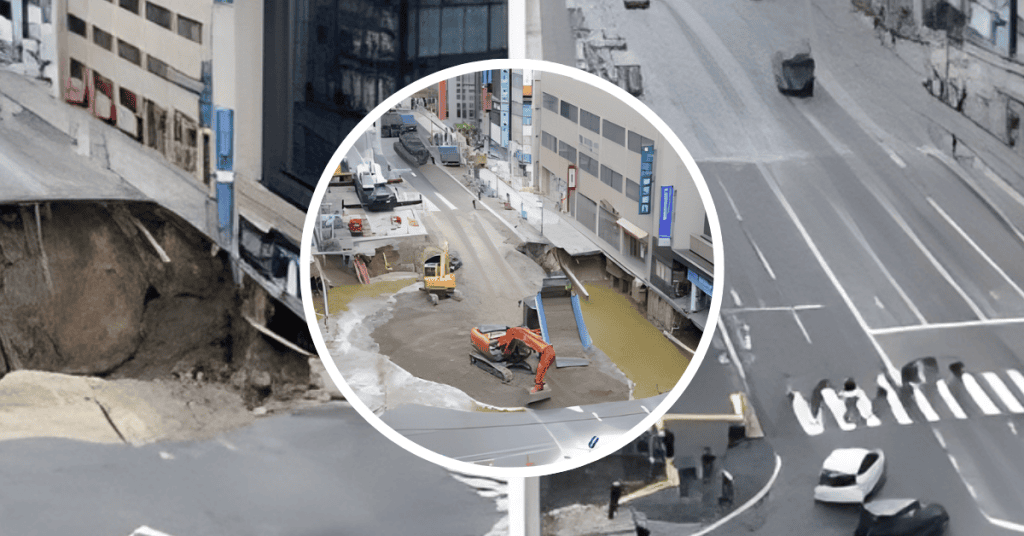
City officials coordinated across departments instead of debating responsibility. There were no public disputes over jurisdiction, no visible paralysis while decisions were escalated. The emphasis was practical and immediate: secure the site, restore essential services, and make the area safe for daily life as quickly as possible.
Within forty-eight hours, the road reopened.
Fresh asphalt covered the site. Lane markings were repainted. Sidewalks were restored. Traffic flowed through the intersection again as if the ground had never given way beneath it. For many watching from outside Japan, the speed of the repair was almost as startling as the collapse itself.
Later investigations traced the cause to nearby subway construction, a reminder that even highly advanced systems can fail. Urban environments are complex, and progress always carries risk. But the real significance of the event was not the mistake that triggered it. It was the response that followed.
There was no rush to assign blame before action. No prolonged spectacle of uncertainty. The order of priorities was clear: fix what is broken first, then determine why it broke. Accountability could wait until stability was restored.
This story continues to resonate because disasters do more than damage infrastructure. They expose values. They reveal whether systems are designed for resilience or for excuses, whether expertise is trusted or sidelined, and whether coordination is practiced or merely promised. Preparation, competence, and quiet cooperation rarely attract attention, but when everything collapses, they are what make recovery possible.
Sometimes the most impressive response to a crisis is not how loudly a city reacts, but how efficiently it returns to the work of everyday life.