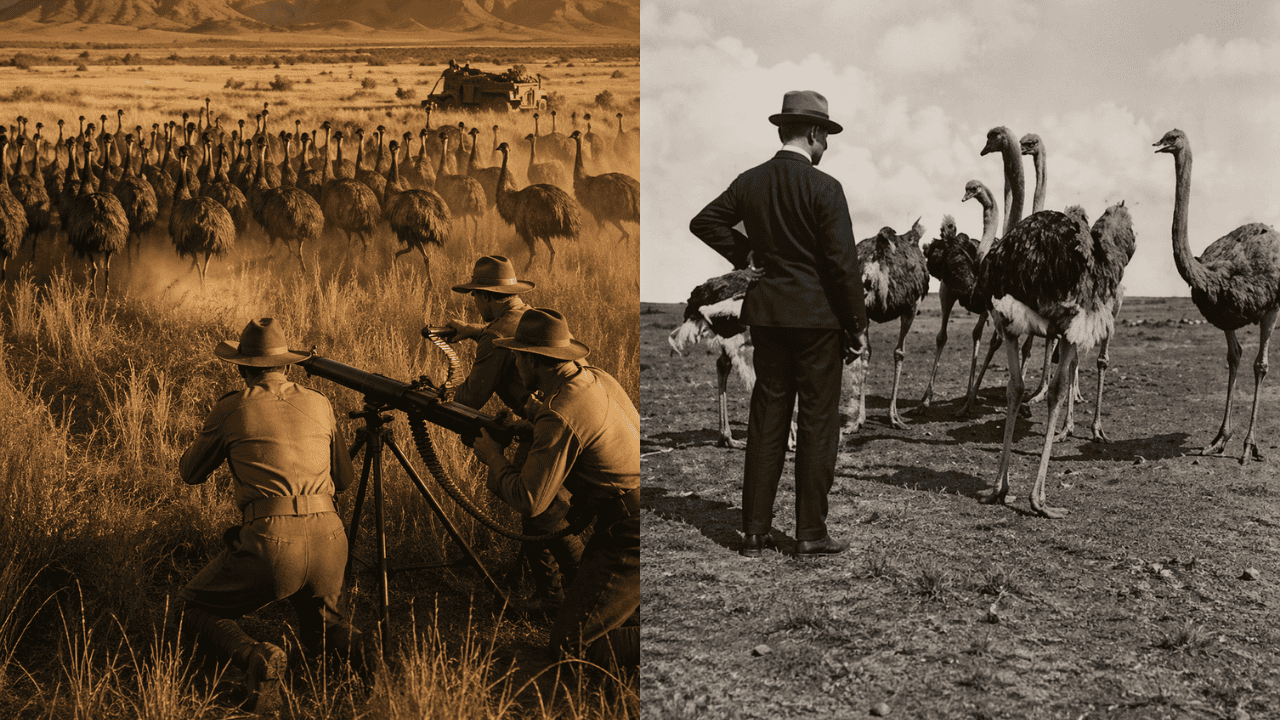
In 1932, an unusual and often overlooked chapter in history unfolded in Western Australia—one that would later be remembered as the “Great Emu War.” What began as a practical attempt to protect farmland quickly turned into a surprising and humbling encounter between humans and nature.
During this period, Australian farmers were facing a serious समस्या. Large numbers of emus—flightless birds native to the region—were migrating inland after breeding season. These birds, numbering around 20,000, began invading farmland, particularly wheat fields. As they moved in massive groups, they caused widespread damage to crops, threatening the livelihoods of farmers already struggling during the Great Depression.
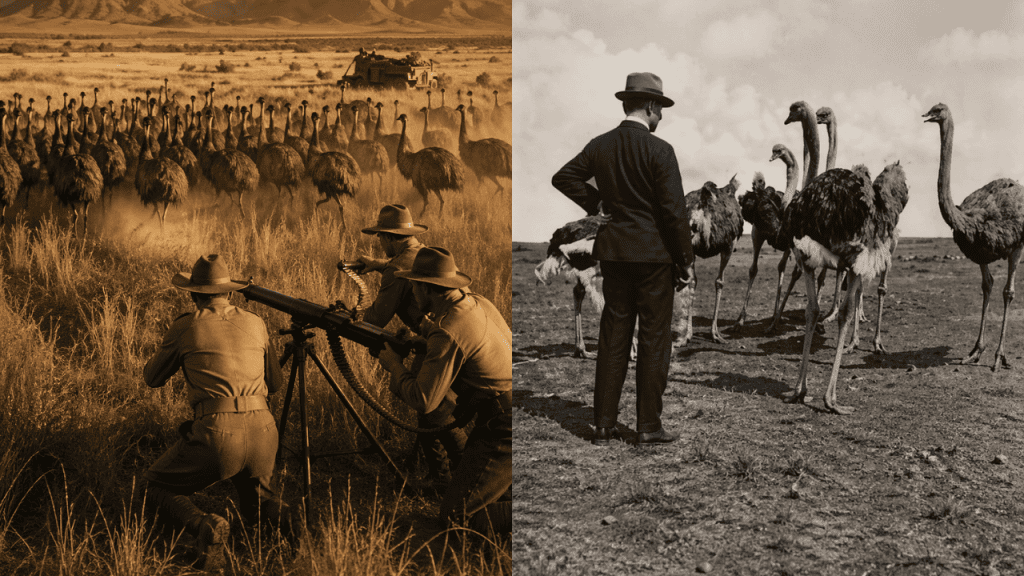
Frustrated and desperate for a solution, the farmers sought help from the government. In response, the Australian military was deployed—not for combat against a human enemy, but to deal with the growing emu population. Armed with two Lewis machine guns and a small team of soldiers, the mission seemed straightforward: reduce the number of birds and protect the crops.
However, things did not go as planned.
The emus proved to be far more resilient and unpredictable than expected. When the soldiers attempted to engage them, the birds did not behave like a stationary target. Instead, they scattered quickly, moving in different directions and making it difficult to aim effectively. In one instance, when a large group of emus came within range, one of the machine guns jammed at a critical moment, allowing the birds to escape.
Despite repeated efforts, the soldiers struggled to make a significant impact. The emus adapted quickly, often breaking into smaller groups that were harder to track and target. Their speed and awareness gave them a clear advantage in the open terrain.
After six weeks of attempts and nearly 10,000 rounds of ammunition used, the operation was called off. The results were far from what had been expected. While some birds were killed, the overall emu population remained largely unaffected, and the damage to crops continued.
In the end, the mission was widely viewed as a failure. Major Meredith, who led the operation, eventually withdrew the troops, and the situation became an example of how even modern military tactics can fall short against nature’s unpredictability.
The “Great Emu War” remains one of the most unusual events in military history. It highlights not only the challenges of managing wildlife but also the limits of human control when faced with natural forces.
Today, the story is often remembered with a mix of humor and reflection. While it may seem unusual, it serves as a reminder that not every problem can be solved with القوة alone—and that sometimes, nature has the final say.