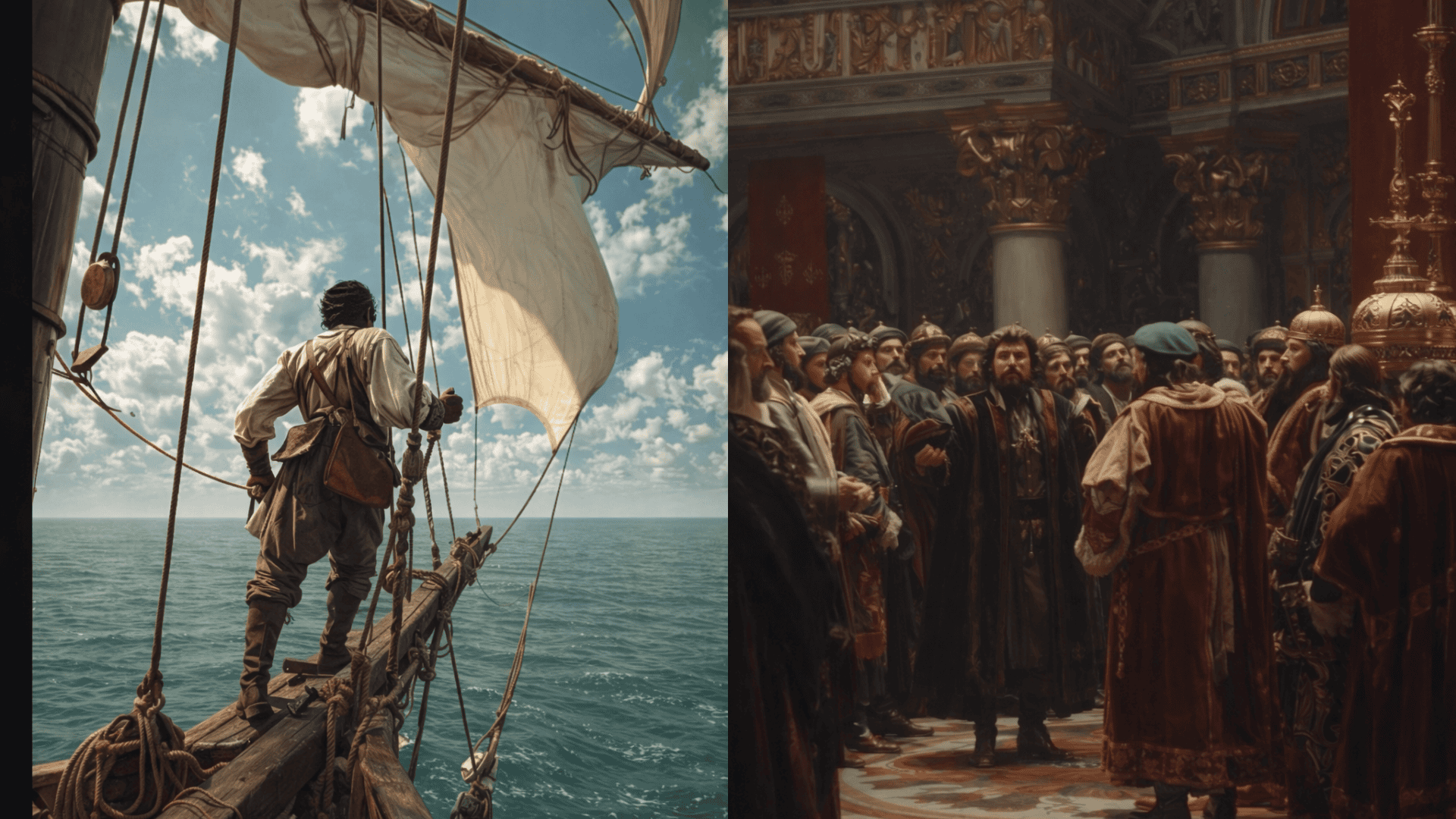
In 1492, when Christopher Columbus sailed west across the Atlantic, he was convinced he could reach Asia faster by crossing the ocean instead of traveling east around Africa. It was a bold idea but it was built on a critical miscalculation.
Columbus believed the Earth was smaller than it actually is. While many people today assume medieval Europeans thought the world was flat, educated scholars of the time already understood it was spherical. The real disagreement centered on distance. Columbus drastically underestimated the size of the globe and the width of the ocean between Europe and Asia. In fact, scholars in Portugal and Castile rejected his proposal largely because their calculations were more accurate. They understood that Asia lay much farther west than Columbus claimed, making the voyage far more dangerous and likely impossible with the ships and supplies available.
After being turned down in Portugal, Columbus eventually secured support from the Spanish monarchs Ferdinand and Isabella in 1492. When he reached the islands of the Caribbean that October, he believed he had arrived near Asia specifically the outskirts of the Indies. This belief shaped everything that followed. He referred to the people he encountered as “Indios,” a term that would evolve into “Indians,” reflecting his conviction that he had reached the Indian Ocean region.
What is striking is that Columbus never publicly accepted that he had encountered a previously unknown continent. Even as subsequent voyages revealed vast lands and civilizations unlike those described in Asian travel accounts, he maintained that he had reached parts of Asia. Until his death in 1506, Columbus insisted that the territories he explored were connected to the eastern regions of the known Asian world.
Meanwhile, other explorers began to question that assumption. Voyages by figures such as Amerigo Vespucci suggested that these lands were not Asia at all, but an entirely separate landmass previously unknown to Europeans. Over time, maps changed. The realization slowly took hold that Columbus had not found a western sea route to India he had stumbled upon continents that would later be called the Americas.
The irony is powerful. Columbus set out to prove the scholars wrong about distance, yet their mathematics had been closer to reality than his own. He did not discover Asia, and he did not recognize that he had encountered a “New World.” Still, his voyages permanently linked Europe and the Americas, triggering waves of exploration, conquest, trade, and colonization that reshaped global history.
Christopher Columbus may never have accepted what he truly found. But history eventually did.