
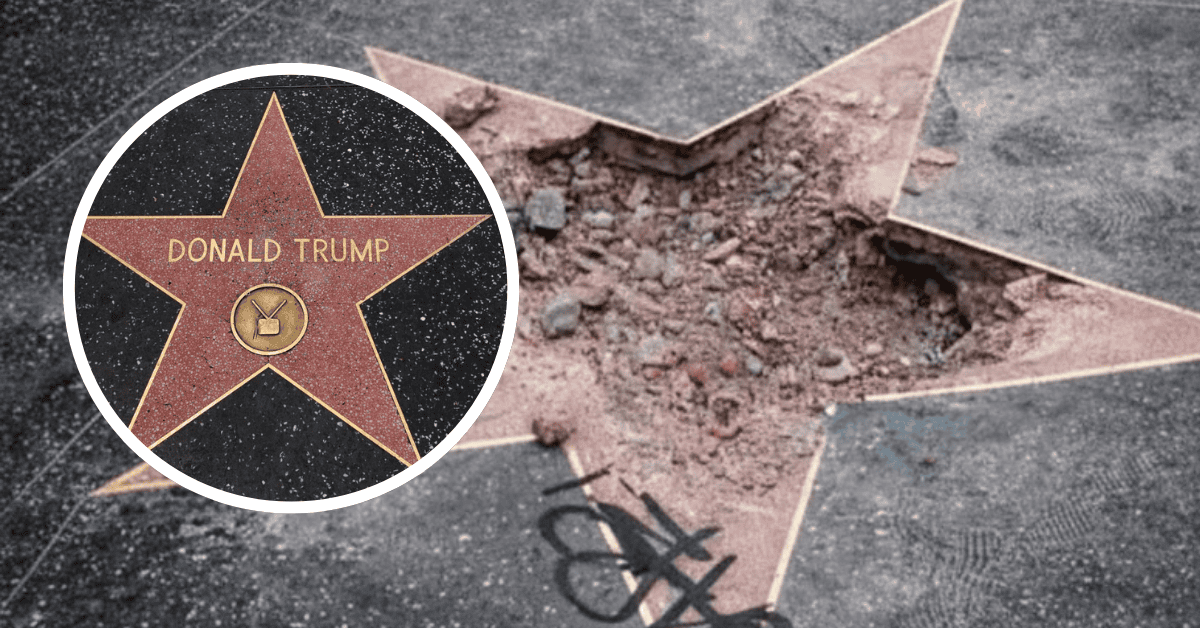
Most people remember the images – shards of terrazzo, a pickaxe raised in anger, tourists stopping to stare. Fewer people remember what happened after. And almost no one knows how strangely the story folded back on itself.
In October 2016, at the height of a tense and emotional election season, a man named James Otis walked onto Hollywood Boulevard carrying a pickaxe and a sledgehammer. In full view of cameras and passersby, he smashed Donald Trump’s star on the Hollywood Walk of Fame. The act was loud, symbolic, and impossible to ignore. Otis later turned himself in, faced felony vandalism charges, and was sentenced to probation, community service, and restitution. The star was repaired. Tourists returned. The news cycle moved on.
It felt like one more explosive moment in a year filled with them.
Two years later, in July 2018, history repeated itself almost exactly.
This time, it was a 24-year-old man named Austin Clay. He arrived at the same stretch of sidewalk, pulled a pickaxe from a guitar case, and smashed the same star. Police arrested him at the scene. Bail was set at $20,000. Once again, images spread across social media, and once again, the act became a symbol — of anger, protest, division, or defiance, depending on who was watching.
But what happened next didn’t fit the usual narrative.
As Clay sat in jail waiting for his case to move forward, someone stepped in to help post his bail. It wasn’t a political organization. It wasn’t a legal fund. It wasn’t a celebrity activist.
It was James Otis.
The same man who had smashed the star in 2016.
According to multiple reports at the time, Otis publicly offered to help Clay get out of jail, saying he wanted to support him. The original vandal had become the benefactor of the next. The story barely registered amid louder headlines, but its implications were hard to ignore.
Seen one way, it was irony. Seen another, a strange act of solidarity. Or perhaps it was something quieter and more unsettling — a reminder of how easily political symbols turn into cycles, where outrage repeats itself without ever resolving into something lasting.
The star itself was repaired again. The sidewalk returned to normal. People took photos. Life went on.
But the pattern lingered.
What started as an act meant to shock became a reenactment. The same weapon. The same target. The same street. Different faces, same gesture. A loop of performance that changed nothing about the symbol it tried to destroy.
It raises an uncomfortable question: when protest becomes repetition, does it lose its power? When symbols are attacked again and again, do they weaken — or do they simply absorb the blow and remain?
Sometimes what looks like rebellion is not transformation, but history replayed, stripped of context and urgency. Sometimes outrage becomes ritual. Sometimes action becomes echo.
And sometimes, the most revealing part of a story isn’t the moment of destruction — but what quietly happens afterward, when the cameras are gone and the same names reappear, circling the same broken tile.