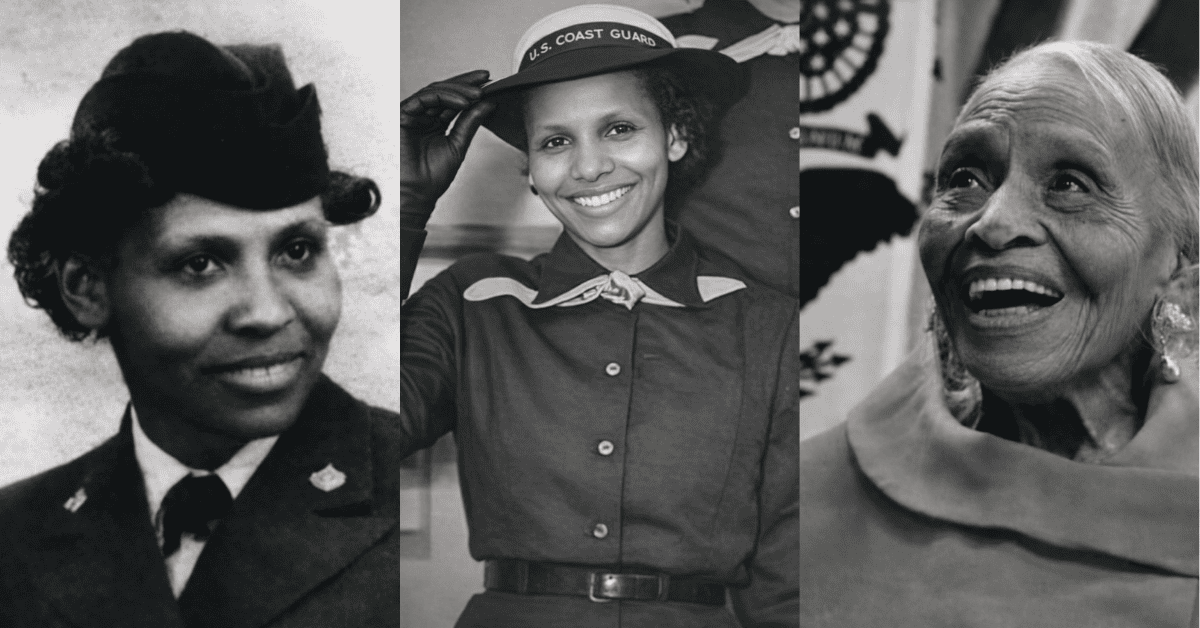
Olivia Hooker learned what violence looked like before she learned what safety meant.
She was just six years old in 1921 when white mobs attacked the Greenwood District of Tulsa, Oklahoma one of the most prosperous Black communities in America. Her family’s home was invaded. Gunfire filled the streets. Buildings burned. By the end, hundreds were dead, thousands were displaced, and an entire community had been erased in what would later be known as the Tulsa Race Massacre.
For decades, the event was barely acknowledged.
Olivia survived, but the trauma followed her. Like many survivors, she grew up in a country that refused to name what had happened. There were no apologies. No justice. Just silence.
She carried on anyway.
Olivia pursued education with determination, believing that understanding the human mind might help make sense of the violence she had witnessed. But before academia, she chose service.
In 1945, during World War II, Olivia Hooker enlisted in the United States Coast Guard. In doing so, she became the first African American woman to serve in the Coast Guard—at a time when both the military and society at large were deeply segregated.
She served with distinction.
Her enlistment was not symbolic. It was an assertion of belonging in a nation that had failed to protect her as a child. She wore the uniform with pride, even as discrimination remained an everyday reality.
After her military service, Olivia returned to her pursuit of education. She earned a doctorate in psychology and dedicated her career to teaching, counseling, and advocacy. She worked extensively with survivors of trauma, including victims of war and displacement, drawing from her own lived experience.
She understood trauma not as weakness, but as something that demanded acknowledgment and care.
For much of her life, Olivia spoke little about the Tulsa massacre publicly. Like many survivors, she had learned that the world did not want to listen. That changed late in her life, when renewed efforts to uncover the truth finally gave survivors space to speak.
Olivia became one of the last living witnesses.
She testified. She educated. She demanded recognition not for herself, but for those who never had the chance to tell their stories. She emphasized that memory was not about dwelling in pain, but about preventing its repetition.
Olivia Hooker lived to be 103 years old.
Her life spanned centuries of change, but her message remained consistent: survival is not the end of the story. What matters is what comes after how you live, how you serve, and how you insist on truth.
She was a survivor.
A trailblazer.
A scholar.
And a reminder that even when history tries to bury the truth, there are people who live long enough to make it rise again.