
For most of her life, Iris Apfel wasn’t famous. She wasn’t photographed. She wasn’t invited to fashion weeks or red carpets. In an industry obsessed with youth and conventional beauty, she was often told directly or indirectly that she didn’t fit the mold.
So she didn’t chase it.
Born in 1921 in New York City, Iris built a long, quiet career in textiles and interior design. Alongside her husband, Carl Apfel, she worked on restoration projects for historic buildings, including assignments for the White House across multiple administrations. Her work required taste, research, and an eye for detail but not attention.
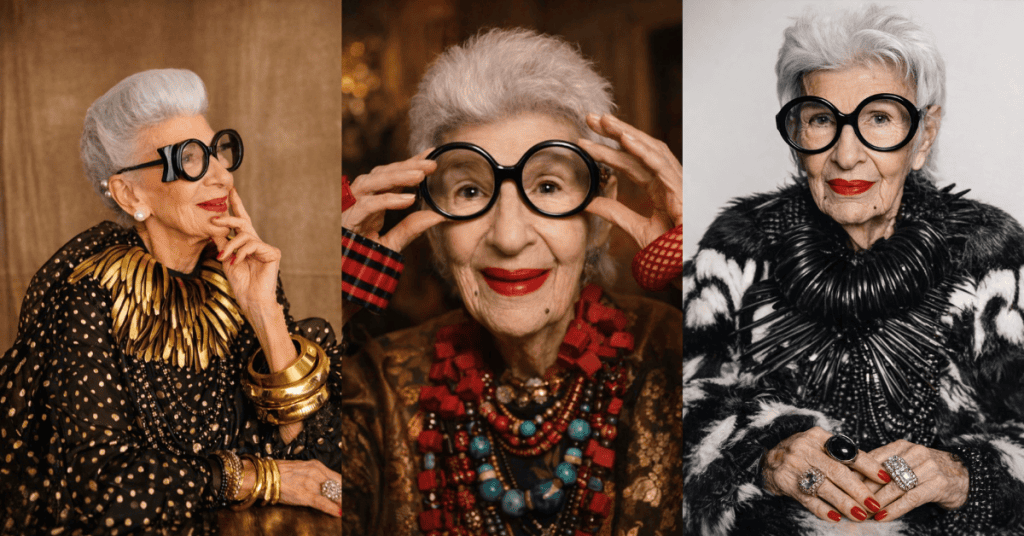
Fashion, for Iris, was personal. She collected clothing and accessories from flea markets, artisans, and cultures around the world. She dressed for herself, not for approval. Oversized glasses, bold jewelry, clashing colors her style was instinctive, not strategic.
For decades, almost no one outside her circle noticed.
That changed in 2005, when the Metropolitan Museum of Art mounted an exhibition of her wardrobe titled Rara Avis (Rare Bird): Selections from the Iris Apfel Collection. Iris was 84 years old. The show was never meant to be a blockbuster. It became one anyway.
Visitors were captivated.
Here was a woman who broke every fashion “rule” and looked unmistakably herself. No airbrushing. No apology. No attempt to look younger than she was. The exhibition introduced Iris Apfel to the world and the world responded.
Suddenly, she was everywhere.
In her late 80s and 90s, Iris became a global fashion icon. She signed modeling contracts, collaborated with major brands, gave interviews, and became a symbol of fearless self-expression. People didn’t admire her because she fit the industry. They admired her because she never tried to.
What made Iris Apfel extraordinary wasn’t late success it was late recognition.
She had always been herself. The world just took a long time to catch up.
Iris spoke openly about aging, beauty, and authenticity. She rejected the idea that style belonged to the young. She believed creativity didn’t expire and that individuality mattered more than elegance.
“Pretty” was never her goal.
Truth was.
Iris Apfel lived past 100, spending her final decades proving something radical in a youth-obsessed culture: that confidence has no age limit, and originality doesn’t need permission.
She didn’t reinvent herself in old age.
She was finally seen.
And in being seen, she changed how the world looked at style not as something to conform to, but something to claim.
Sometimes the spotlight doesn’t arrive early.
Sometimes it arrives exactly when it’s needed to prove that authenticity outlasts every trend.