
When Lowell Bjerk, a lifelong farmer in Reynolds, North Dakota, passed away suddenly, he left behind more than fields of corn waiting to be harvested. He left behind a grieving wife, a year’s worth of work unfinished, and a silence that settled heavily over the land he had spent his life tending.
For Marlene Bjerk, the loss was overwhelming. In the midst of mourning her husband, she was suddenly faced with an impossible reality — 1,400 acres of corn still standing in the fields, and no way to harvest it alone. The work Lowell had always handled was now hers to face, even as she tried to navigate the shock and heartbreak of losing her partner.
But Marlene was not as alone as she feared.
Word quietly spread through the farming community. Neighbors talked. Phone calls were made. And without fanfare or expectation of recognition, farmers across the area made a collective decision: they would finish Lowell’s harvest for him.
On the chosen day, the Bjerk farm transformed into a scene few will ever forget. One by one, dozens of volunteers arrived, bringing with them everything needed to complete the job — 11 combines, 12 grain carts, and 15 semi-trucks. Engines roared to life as machinery lined the fields, all there for one reason: to help a neighbor in need.
What would normally take weeks for a single farmer to accomplish was completed in just seven hours.
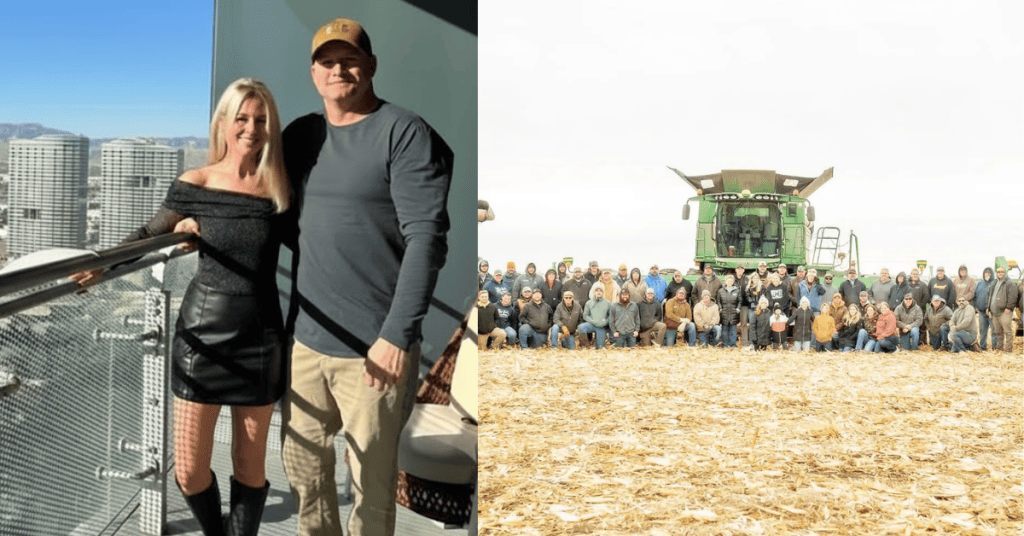
Rows of corn disappeared as machines worked side by side, moving in quiet coordination. The harvest rolled on with purpose, efficiency, and deep respect — not just for the work, but for the man who had once walked those same fields.
Organizers later shared that many of the volunteers had put aside their own pressing chores, businesses, and responsibilities to be there. This wasn’t about convenience. It was about loyalty. About honoring Lowell, a man they knew, respected, and farmed alongside for years.
For Marlene, the sight was overwhelming.
In the middle of her grief, she witnessed a powerful reminder of what her husband had meant to others — and of the strength of a community that refused to let her face loss alone. The harvest ensured the family’s livelihood for the year, lifting a heavy financial burden at a time when everything already felt uncertain.
But more than that, it offered comfort.
This was not charity. It was solidarity.
In rural communities like Reynolds, help doesn’t always come with speeches or headlines. Sometimes it comes in the form of neighbors showing up at dawn, climbing into tractors, and working until the job is done — simply because it’s the right thing to do.
The harvest became more than an act of labor. It was a tribute — a final chapter written not in words, but in action. Each acre harvested honored a farmer who had given his life to the land, and each volunteer reflected the values Lowell lived by: hard work, humility, and community.
In the face of sudden loss, the fields did not stand empty. They were filled with people — proving that even in grief, no one stands alone when a community chooses to stand together.