
When Nazi Germany invaded the Soviet Union in 1941, millions were drawn into one of the most brutal conflicts in history. Among them was Lyudmila Pavlichenko, a young woman who made a decision that would place her on the front lines—and eventually among the most feared snipers of the war.
Pavlichenko volunteered to fight and was quickly assigned a rifle, sent directly into combat in places like Odessa and Sevastopol. What followed was a period of intense and relentless warfare, where survival depended on precision, patience, and mental strength. In this environment, she developed into one of the most effective snipers in military history.
Over the course of her service, she recorded 309 confirmed kills, including enemy snipers sent specifically to eliminate her. Her presence alone created a psychological impact. Enemy soldiers learned to fear stillness and silence, knowing that danger could come from anywhere.
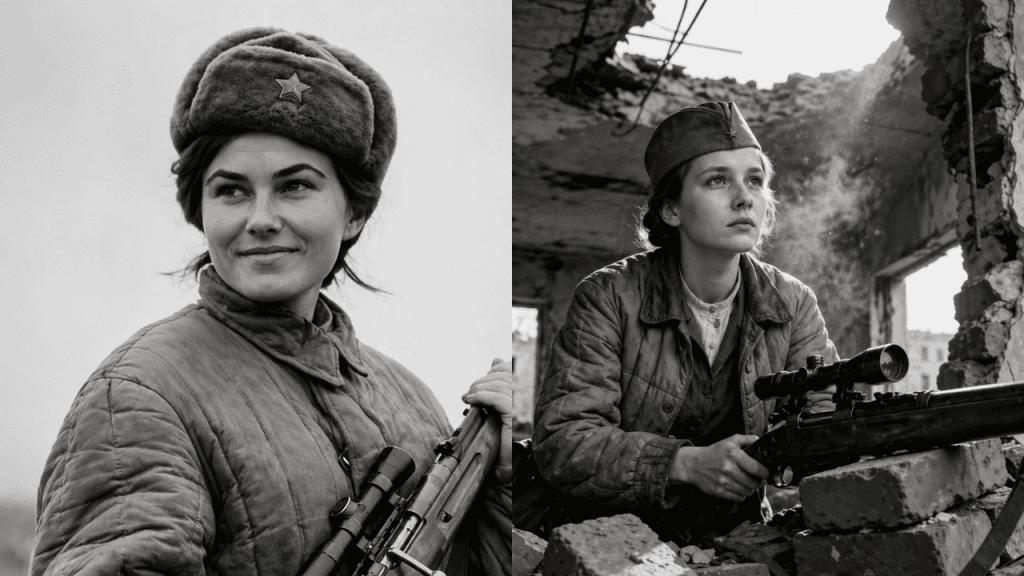
But her story is not only about numbers.
Behind every shot was a human cost. Pavlichenko later spoke openly about the emotional weight she carried—the reality of taking lives, even in the context of war. Unlike the simplified image of a sniper as a distant figure, her experience reflected the complexity of combat and the lasting impact it leaves on those who endure it.
In 1942, she was wounded by mortar fire and removed from the front lines. Rather than returning to combat, she was sent abroad as part of a diplomatic effort to build support for the Soviet war effort. During this time, she became a powerful speaker, addressing audiences who were often skeptical of a woman’s role in direct combat.
In one of her most well-known moments, she challenged that skepticism directly, calling out those who questioned her experience. Her words reflected not only confidence, but a demand for recognition—both for herself and for the many women who had taken up arms.
After the war, Pavlichenko lived on, but like many veterans, she carried the memories of what she had experienced. The الحرب had shaped her life in ways that could not be undone.
Her legacy stands at the intersection of courage and reality. She was a soldier, a symbol, and a voice—someone who proved that strength in war is not only measured by action, but also by the ability to confront its consequences.
Lyudmila Pavlichenko survived the war.
But the war, in many ways, never left her.