
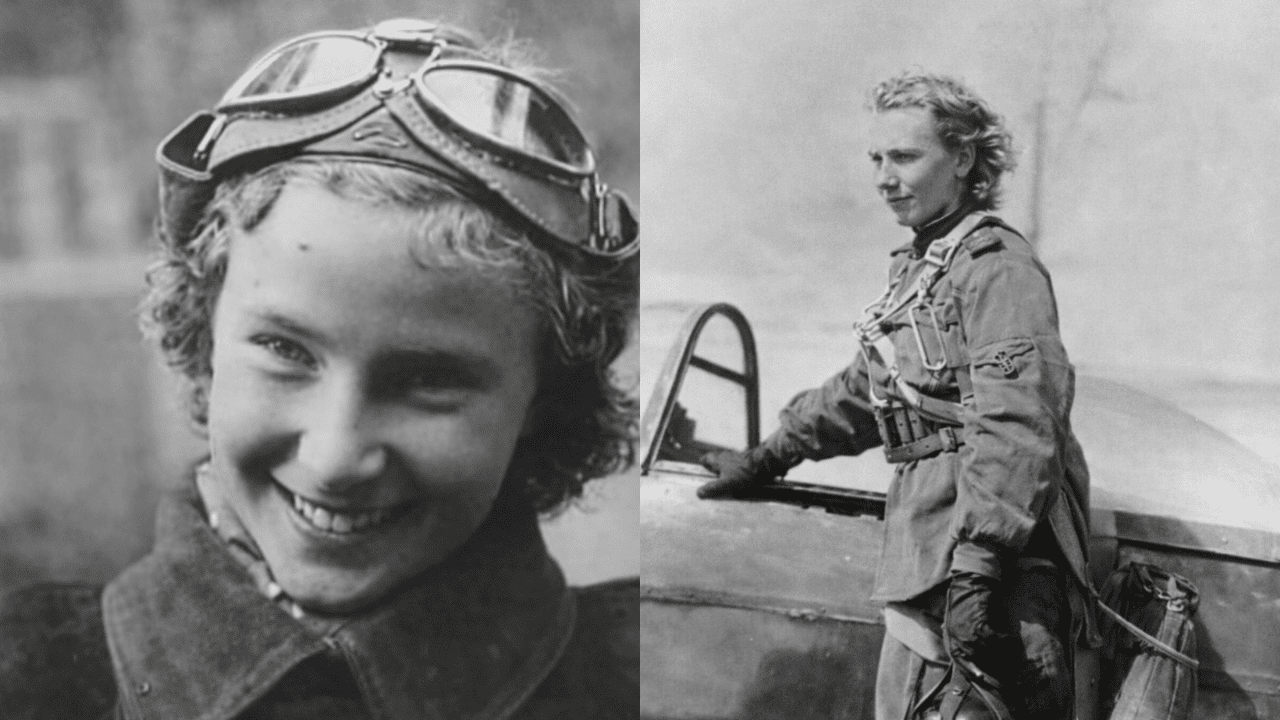
When the skies above Stalingrad turned into a battlefield of fire and steel, one young pilot flew directly into the chaos with remarkable courage. Lidia Litvyak, barely in her twenties, would become one of the most legendary figures of World War II aviation, earning a place in history as the highest-scoring female fighter ace.
Born in Moscow in 1921, Lidia showed an early fascination with flight. She joined a flying club as a teenager and quickly proved she had both the skill and determination needed to master the air. By the time war reached the Soviet Union in 1941, she was already a trained pilot, ready to defend her country. Like many women aviators of the time, she initially flew in all-female units, but her talent soon set her apart.
Litvyak was later assigned to a regular fighter regiment, flying the Yak-1 aircraft in some of the most intense air battles of the war. It was over Stalingrad, one of the deadliest and most decisive battles of World War II, that she truly made her mark. The skies there were thick with enemy aircraft, anti-aircraft fire, and smoke rising from the devastated city below. For many pilots, it was a place of fear. For Litvyak, it became a proving ground.
What made her stand out was not just her bravery, but her precision. She engaged German fighters and bombers repeatedly, demonstrating sharp instincts and control under pressure. Her aircraft, often noted for the flowers painted on its fuselage, became a familiar sight in the skies. Despite the constant danger, she returned from mission after mission, building a record of confirmed victories that few could match.
Over time, Litvyak was credited with shooting down multiple enemy aircraft, securing her status as a fighter ace. Her achievements were extraordinary not only because of her skill, but also because she operated in an environment where the odds were often against survival. Each flight carried the risk of never returning.
Yet the war demanded everything, and even the most skilled pilots were not immune to its cost. In August 1943, during a mission over the Donbas region, Litvyak’s aircraft did not come back. She was just 21 years old. For years, her fate remained uncertain, and she was initially listed as missing in action.
Decades later, the crash site was finally located, and her story was confirmed. In 1990, she was posthumously awarded the title Hero of the Soviet Union, one of the nation’s highest honors. By then, her legacy had already taken shape among historians and aviation enthusiasts.
Lidia Litvyak’s story is not only about aerial victories or wartime heroics. It is about a young woman who entered one of history’s most brutal conflicts and proved that courage and skill know no boundaries. In a sky filled with danger, she carved out a place of mastery, leaving behind a legacy that continues to inspire generations.
For a brief moment in history, she did not just fly—she ruled the skies.