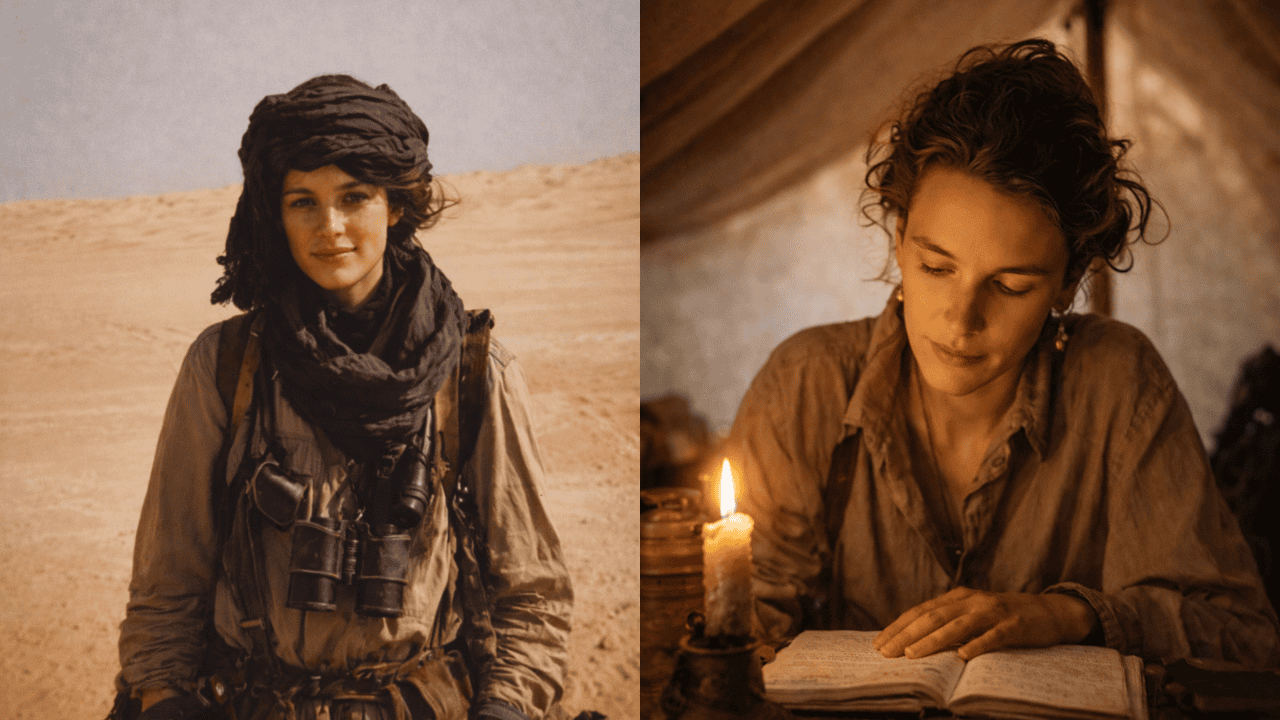
In 1931, at a time when much of the Arabian Peninsula remained unknown to Western audiences, British explorer Freya Stark set out on a journey that would redefine what exploration meant. Armed not with large expeditions or heavy support, but with notebooks, maps, and an unshakable curiosity, she ventured into landscapes that few Europeans—especially women—had ever seen.
Freya Stark was not driven by conquest or fame. What drew her forward was a deep fascination with cultures, languages, and the stories of the people who lived far beyond the familiar boundaries of Europe. Traveling largely alone, she moved through vast deserts, rugged mountains, and remote villages, often in regions where outsiders were rarely welcomed. For a woman to do this in the early twentieth century was extraordinary.
The Arabian Peninsula at that time was a place of mystery to many in the West. Stark approached it differently. Rather than observing from a distance, she immersed herself in the environments she encountered. She learned local customs, listened to stories, and paid close attention to the details of everyday life. In villages where foreign presence—especially that of a woman—was unusual, she managed to gain trust through patience and respect.
Her journeys were not without hardship. The desert demanded endurance, and the terrain could be unforgiving. Travel conditions were often difficult, with limited resources and constant uncertainty. Yet Stark continued, guided by a belief that understanding the world required stepping beyond comfort and familiarity.
What set her apart was not only where she went, but how she recorded it. Her writing brought distant places vividly to life. Through her travel books, readers were introduced to landscapes of sweeping الرمال and towering mountains, as well as the people who called those places home. She wrote with clarity and sensitivity, avoiding the detached tone common in many travel accounts of her time.
Her work helped reshape Western perceptions of the Middle East. Instead of portraying the region as distant or exotic in a simplistic sense, she presented it as complex, rich, and deeply human. Her observations offered insight into cultures that had often been misunderstood or overlooked.
Freya Stark’s journeys opened doors—not just geographically, but intellectually. She showed that exploration could be as much about listening and learning as it was about discovery. In doing so, she paved the way for future generations of travelers, particularly women, to venture into parts of the world once considered inaccessible.
Her legacy lives on through her writing and the paths she carved across the Arabian Peninsula. At a time when the world still held vast unknowns, Freya Stark chose not to stand at the edge and wonder. She stepped forward, notebook in hand, and brought those distant horizons closer to the rest of the world.