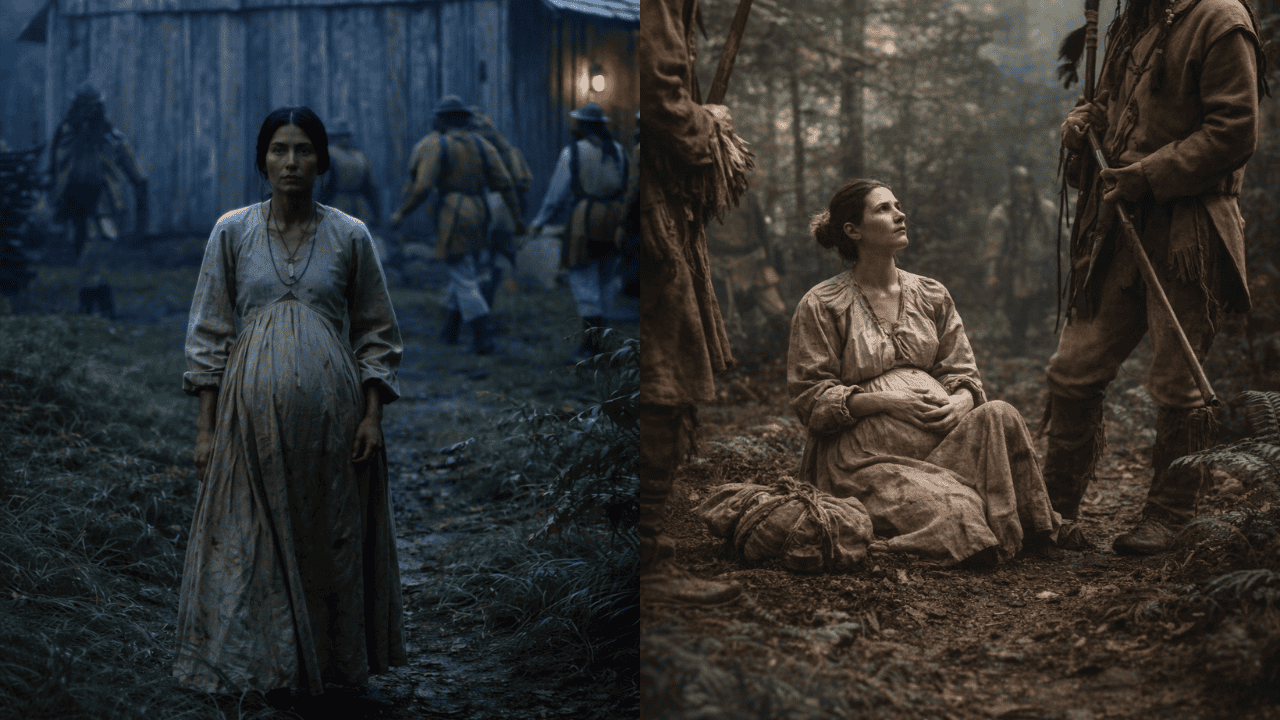
In 1754, on the edge of a growing conflict in colonial North America, Susannah Johnson’s life was suddenly torn from everything she knew. Living in New Hampshire while pregnant, she was captured during an Abenaki raid—one of many such encounters that marked the turbulent years of the French and Indian War. In an instant, her home, her safety, and her future were swept away, replaced by uncertainty and a long, forced journey into the unknown.
What followed was a harsh and exhausting march through wilderness that tested both body and spirit. The terrain was unforgiving, the pace relentless, and survival was never guaranteed. Along the way, Johnson faced one of the most extraordinary moments of her life. Still in captivity, far from any familiar place, she gave birth to her daughter. With no comforts or preparation, she used what little she had—reportedly a simple gourd—as part of a makeshift baptism, naming the child Captive. It was a moment shaped by faith, resilience, and the need to hold onto something meaningful amid chaos.
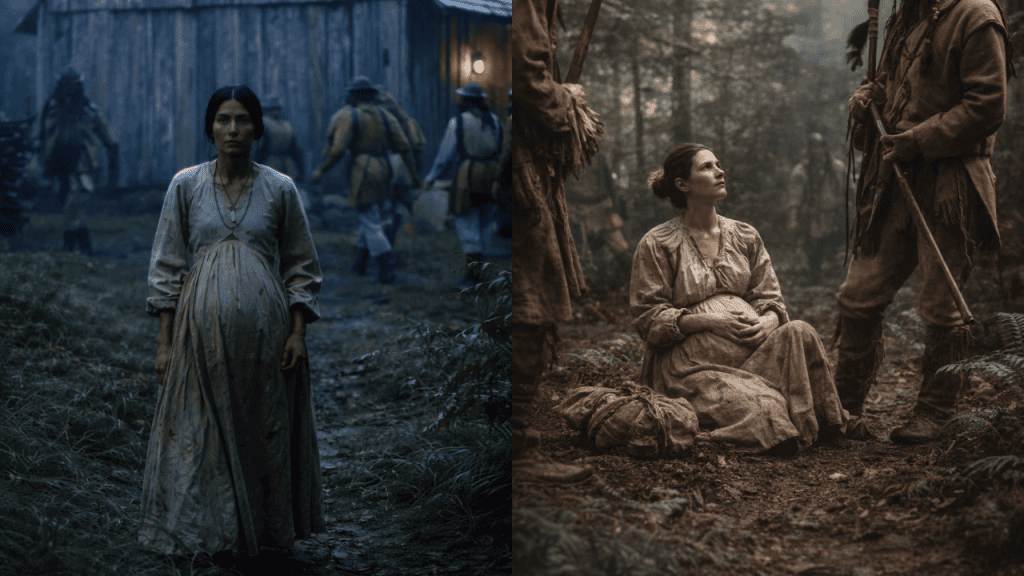
Despite the hardship, Johnson’s experience was not defined by cruelty alone. Accounts from her later memoir suggest that she was treated with a degree of care by her captors, a complexity that reflects the varied realities of captivity during that era. Yet her suffering was far from over. Members of her family were separated and sold, caught in the broader systems of conflict and trade that extended beyond the battlefield. Loss and uncertainty remained constant companions.
Eventually, Johnson herself was sold to the French. It was there, after months of separation and fear, that fragments of her family began to come back together. The reunion, though partial, marked a turning point—a shift from survival toward the possibility of rebuilding what had been broken.
Years later, after she had gone blind, Susannah Johnson wrote her memoir, relying on memory to reconstruct the ordeal she had endured decades earlier. Published in 1796, her account became one of the most widely read examples of the American captivity narrative. It offered readers a deeply personal view into a world shaped by conflict, cultural encounter, and endurance.
Her story is not just one of survival, but of memory—how a life disrupted by violence could still be shaped into something lasting. Through her words, Johnson preserved an experience that might otherwise have been lost, giving voice to both the suffering and the resilience that defined her journey.
In the end, Susannah Johnson’s story endures not because of the hardship alone, but because she lived to tell it—transforming personal tragedy into a narrative that continues to echo through history.