
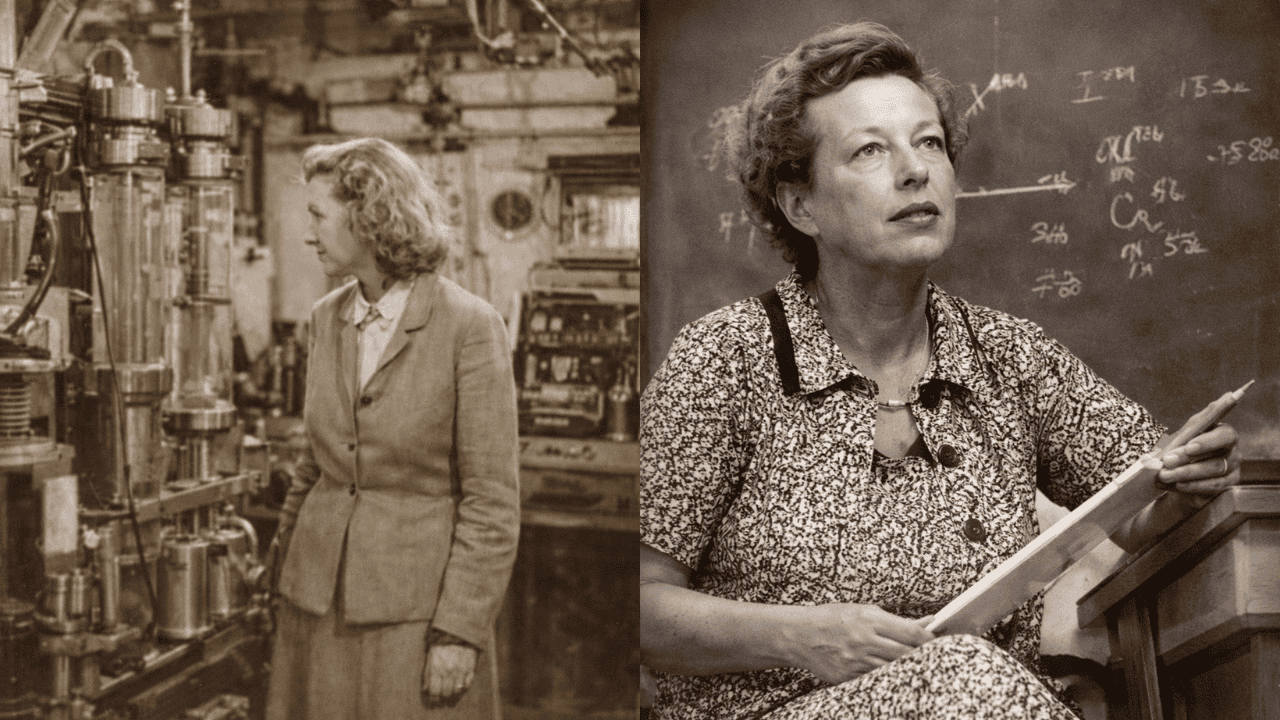
In 1963, Maria Goeppert Mayer stepped onto the Nobel stage and quietly made history. With that moment, she became only the second woman ever to receive the Nobel Prize in Physics—following Marie Curie more than sixty years earlier. It was a rare and long-overdue recognition, not just of her brilliance, but of decades of work carried out largely in the shadows.
Unlike many celebrated scientists, Mayer never sought attention. She was driven by curiosity, by a desire to understand the invisible structure of the universe. Born in Germany and later moving to the United States, she built her life around physics at a time when opportunities for women in science were limited and often informal.
During World War II, Mayer contributed to the Manhattan Project. She worked first at Columbia University, focusing on isotope separation, and later at Los Alamos, where some of the most intense scientific efforts of the war were concentrated. The pace of discovery during those years was extraordinary, but when the war ended, Mayer turned away from military research and toward a deeper, more fundamental question.
Why are some atomic nuclei stable while others are not?
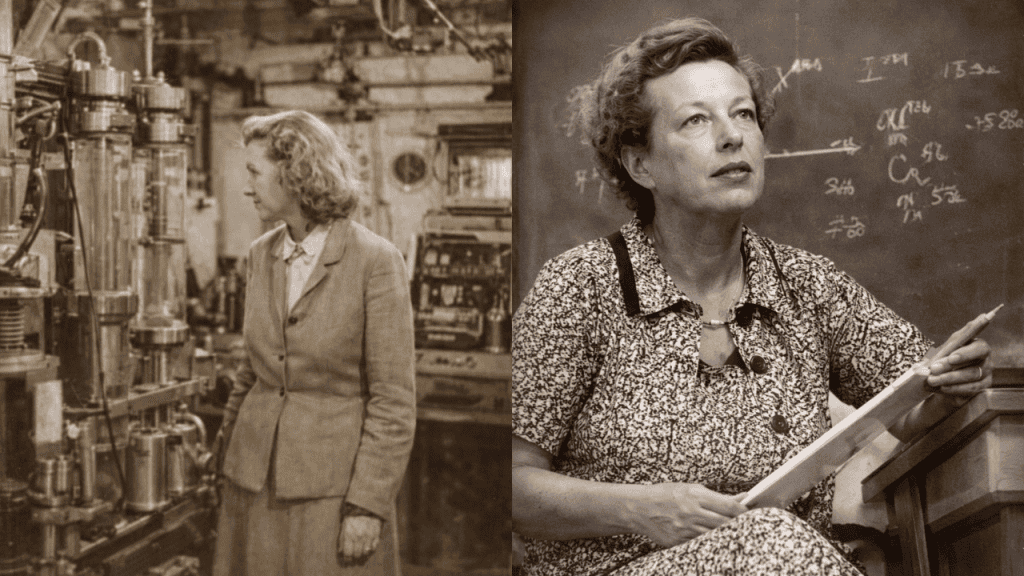
It was a problem that had puzzled physicists for years. The atomic nucleus, made of protons and neutrons, did not behave in simple or predictable ways. Some configurations held together with remarkable stability, while others broke apart quickly. Mayer approached the mystery with patience and imagination.
Between 1948 and 1949, she developed a groundbreaking idea. She proposed that protons and neutrons inside the nucleus are arranged in layers, or “shells,” much like electrons orbiting an atom. When these shells are filled in specific numbers—what would later be called “magic numbers”—the nucleus becomes especially stable.
It was a simple, elegant explanation for a complex phenomenon.
Around the same time, German physicist Hans Jensen arrived at similar conclusions independently. Rather than competing for credit, Mayer and Jensen chose to collaborate. In 1955, they published Elementary Theory of Nuclear Shell Structure, a work that firmly established the shell model as a cornerstone of nuclear physics.
Despite the importance of her research, Mayer’s career had not followed a traditional path. For years, she worked without pay or held unofficial positions, largely because universities were reluctant to hire married women as full professors. Her contributions were undeniable, yet recognition came slowly.
When the Nobel Prize was finally awarded in 1963, it acknowledged not only a revolutionary theory but also a lifetime of persistence.
Maria Goeppert Mayer did not break barriers through loud declarations or public battles. She did it through quiet determination, through careful thought, and through equations that revealed the hidden order of the atomic world.
Her work continues to shape nuclear science today—a lasting reminder that some of the most profound changes in history begin not with noise, but with insight.