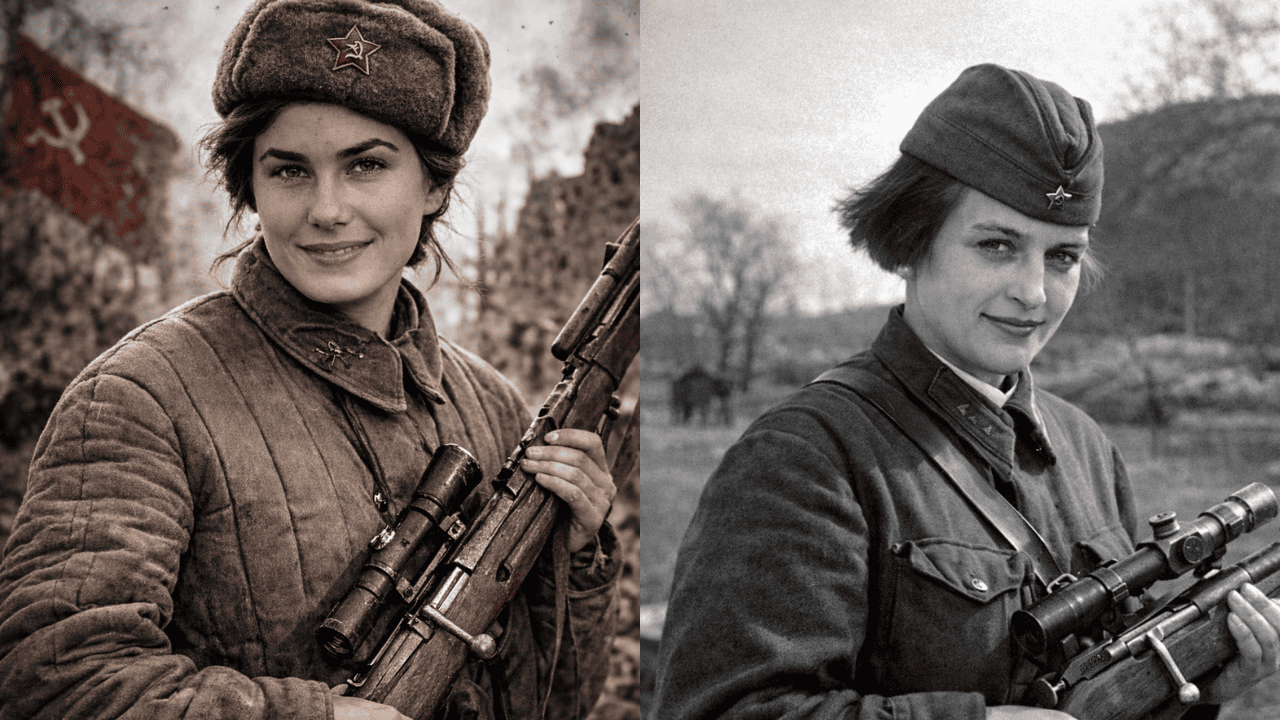
When Nazi Germany launched its invasion of the Soviet Union in 1941, the scale of the conflict was unlike anything Europe had ever seen. Entire cities were thrown into chaos as civilians and soldiers alike were forced to defend their homeland. Among those who stepped forward was a young woman named Lyudmila Pavlichenko—a history student whose life would soon take a dramatic and deadly turn.
At just twenty-four years old, Pavlichenko volunteered to join the Red Army. She was quickly handed a rifle and sent to the front lines, first in Odessa and later in the besieged city of Sevastopol. What awaited her there was not just war, but a relentless struggle for survival, where every street, hill, and ruined building became a battlefield.
From the beginning, Pavlichenko proved she was no ordinary soldier.
Trained as a sniper, she possessed exceptional patience, focus, and precision—qualities that would soon make her one of the most feared marksmen on the Eastern Front. Hidden among rubble, grass, or shattered walls, she would wait for hours, sometimes days, for the perfect moment to take a shot. In the chaos of war, where noise and movement were constant, her stillness became her greatest weapon.
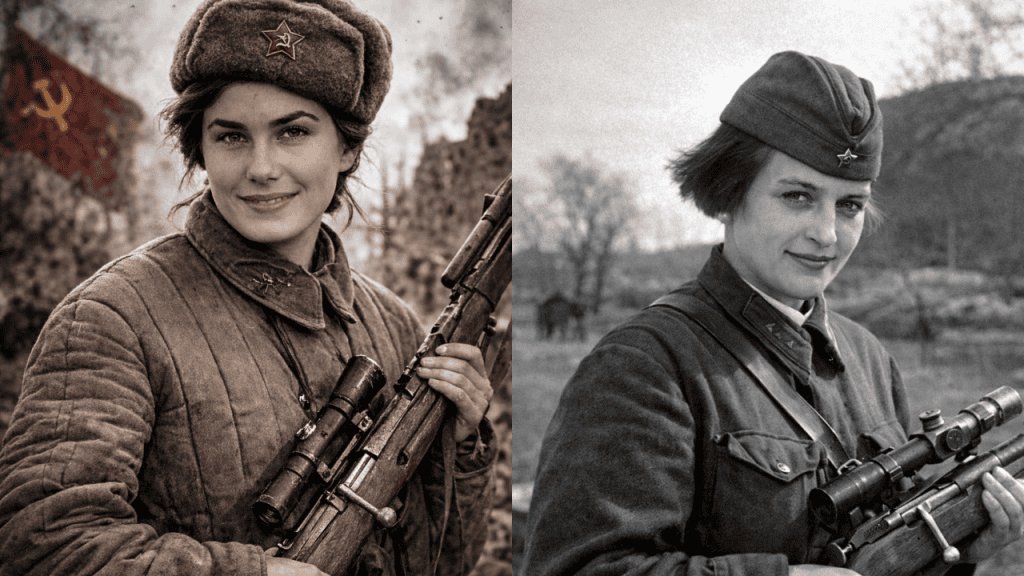
Over the months that followed, her record grew with astonishing speed. Pavlichenko was credited with 309 confirmed kills, including dozens of enemy snipers who had been sent specifically to eliminate her. These were not easy victories. Enemy sharpshooters often sought her out, turning their encounters into tense and deadly duels where the slightest mistake meant death.
Her reputation spread quickly through both Soviet and German ranks.
Among her fellow soldiers, she became a symbol of determination and strength—a reminder that courage on the battlefield was not defined by gender. To her enemies, she became something far more unsettling. German forces reportedly began to fear the quiet stretches of terrain where a single hidden figure could be watching, waiting.
But the war took its toll.
During the brutal fighting in Sevastopol, Pavlichenko was wounded by mortar fire. Despite her injuries, she resisted leaving the front lines, determined to continue fighting alongside her comrades. Only after receiving direct orders was she finally pulled from combat.
By the time she was withdrawn, she had already secured her place in history.
Rather than returning quietly to civilian life, Pavlichenko was sent abroad as part of a Soviet delegation to gather support from Allied nations. In the United States, she spoke openly about the realities of war and challenged the world to recognize the sacrifices being made on the Eastern Front. Her presence alone—calm, composed, and undeniably formidable—left a lasting impression.
Lyudmila Pavlichenko’s story is not just one of numbers, though 309 confirmed kills remains one of the highest records ever achieved by a sniper. It is a story of resilience, discipline, and the extraordinary role individuals can play in moments of global crisis.
In a war defined by vast armies and sweeping battles, she became something far more personal—a silent figure in the distance, whose steady aim and unshakable resolve made her impossible to ignore.