

Emily Dickinson never sought fame.
In fact, she actively avoided it. For most of her life, the world outside her home knew little of her work. She was a quiet, reclusive woman who rarely left her house, spoke to only a handful of visitors, and dressed exclusively in white. But the poems she wrote nearly 1,800 of them would go on to define American poetry.
Her works were discovered only after her death, when her sister found them locked away in a chest. In these poems, Emily’s voice rang out fiercely, with sharp observations about life, death, nature, and the self. At the time, her unconventional style did not fit neatly within the expectations of 19th-century American literature.
Her poems broke every rule.
She didn’t follow traditional forms, instead writing in short, often fragmented verses. She used dashes to create pauses and ambiguity, leaving readers to interpret the meaning behind her words. She defied the conventions of rhyme, structure, and meter, creating an entirely new way of expressing thought and emotion through poetry. In doing so, she anticipated many of the techniques that would later characterize modernism in literature.
At the time of her writing, Dickinson’s work was often dismissed as strange or too eccentric. Her reclusiveness, combined with the mysteriousness of her poems, led many to think of her as an outsider someone not quite part of the literary world. Her personal life and creative output were seen as curiosities, rather than as serious contributions to American culture.
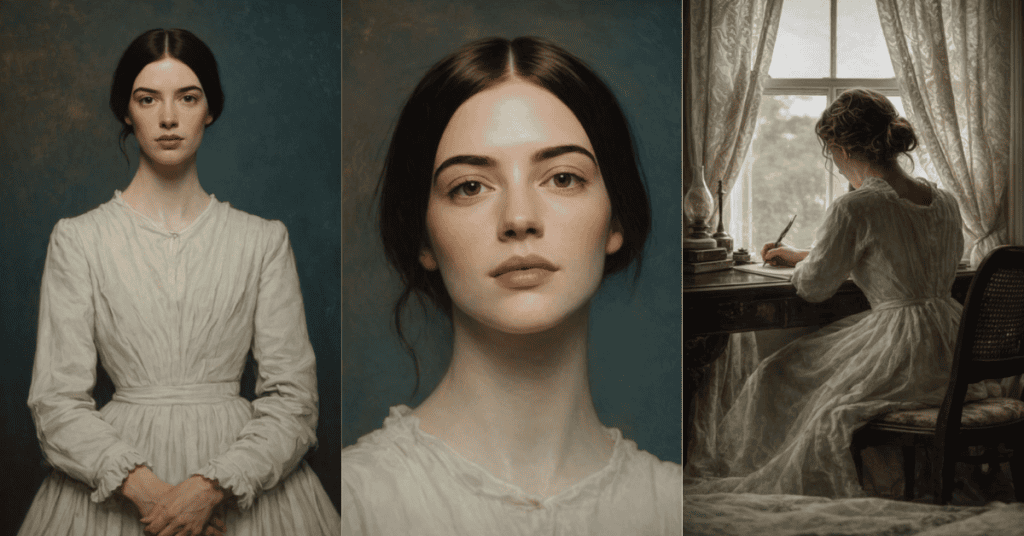
But over time, her work was recognized for its power, its insight, and its innovation.
Dickinson’s poetry has come to be seen as a bridge between 19th-century American literature and the modernist movement. Her unconventional approach to language and form inspired generations of poets and writers, from Walt Whitman to Sylvia Plath, who admired her directness and emotional depth.
Today, Emily Dickinson is celebrated as one of the most important figures in American literature. Her work continues to challenge readers, offering new insights with each reading. She stands not only as a symbol of poetic innovation but also as a testament to the quiet, private lives that can contain extraordinary creativity.
In a world that often rewards visibility, Emily Dickinson’s life reminds us that greatness doesn’t always require recognition in the moment. Her legacy proves that sometimes, it’s the quietest voices that have the most to say.