
The high school thought it had a simple idea.
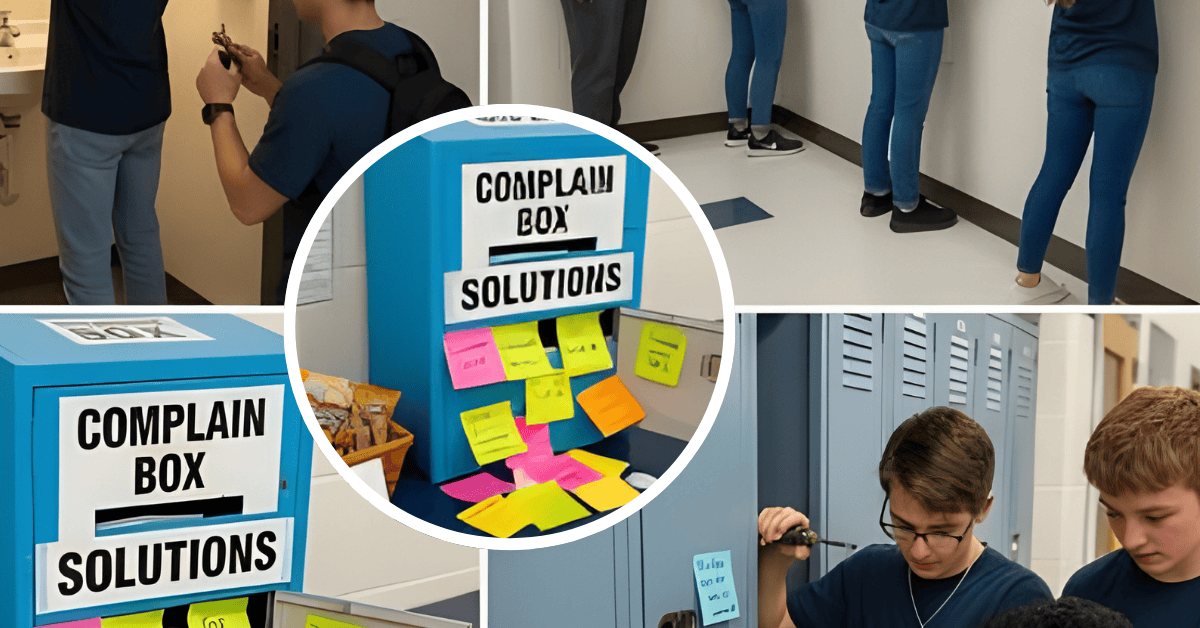
It called it the Complain Box.
Principal Hendricks believed it would help students feel heard. Anyone could anonymously submit complaints. Administration would review them and fix real problems. Transparent. Democratic. Sensible.
It worked immediately.
Too well.
By the end of week one, there were 847 complaint slips.
Some were practical:
- “The cafeteria pizza tastes like cardboard.”
- “Why do we start school at 7:30 a.m.? Teenagers need sleep.”
- “The second-floor bathroom has been out of soap for three months.”
Others… less so:
- “If mitochondria are the powerhouse of the cell, why does my phone die at 20%?”
- “Complaint: I have to walk past my ex’s locker every day.”
- “The library is too quiet. My stomach growls echo.”
Principal Hendricks was buried. He seriously considered shutting the whole thing down.
Then one slip changed everything.
A sophomore named Aisha wrote:
“Why don’t we just fix things ourselves instead of complaining?”
She didn’t wait for permission.
The next morning, the second-floor bathroom had soap again. Aisha had brought it from home and refilled the dispensers. Taped to the mirror was a note:
Problem solved. —A Student
The day after that, someone fixed the wobbly cafeteria table everyone avoided. Another note appeared:
Fixed it. —Also A Student
Something caught fire.
Students started quietly solving problems and leaving anonymous notes behind. They became known as “The Fixers.”
The broken water fountain? Fixed.
The clock that had been wrong for two years? Corrected.
The loose basketball hoop? Tightened.
Then it went beyond repairs.
Someone started free after-school tutoring in the library. No sign-up. No credit. Just help.
Another student made a shared Google Doc with class notes for anyone who missed school.
The Complain Box slowly turned into the Solution Box.
New notes appeared:
- “What if we start a breakfast basket for kids who come to school hungry?”
- “Could we make a tool library so everyone shares?”
- “What if we painted a mural in the parking lot?”
Principal Hendricks stopped intervening. He just watched.
The breakfast program happened. Students brought granola bars and fruit and left them near the entrance with a sign:
Take what you need.
The mural happened too. Art students designed it. Athletes painted. Band kids played music while they worked. The ugliest part of campus became something people stopped to admire.
Local news eventually covered it:
“High School Students Stop Complaining — Start Fixing.”
Other schools tried copying the idea.
They only got complaints.
Because it was never about the box.
It was about one student deciding to act — and others realizing they could too.
Today, the Complain Box is still there. But most of what’s inside are thank-you notes:
- “Whoever fixed my locker, thank you. It actually closes now.”
- “The breakfast basket saved me today.”
- “To the anonymous math tutor — you’re the reason I’m passing.”
Aisha graduated last year. She’s at community college now.
But her idea stayed.
Turns out change doesn’t need funding, approval, or a committee.
It just needs one person willing to stop complaining and start doing.
The rest usually follow.
And now, whenever someone complains at that school, someone else asks:
“Cool. What are you gonna do about it?”
Most of the time, they figure something out.