
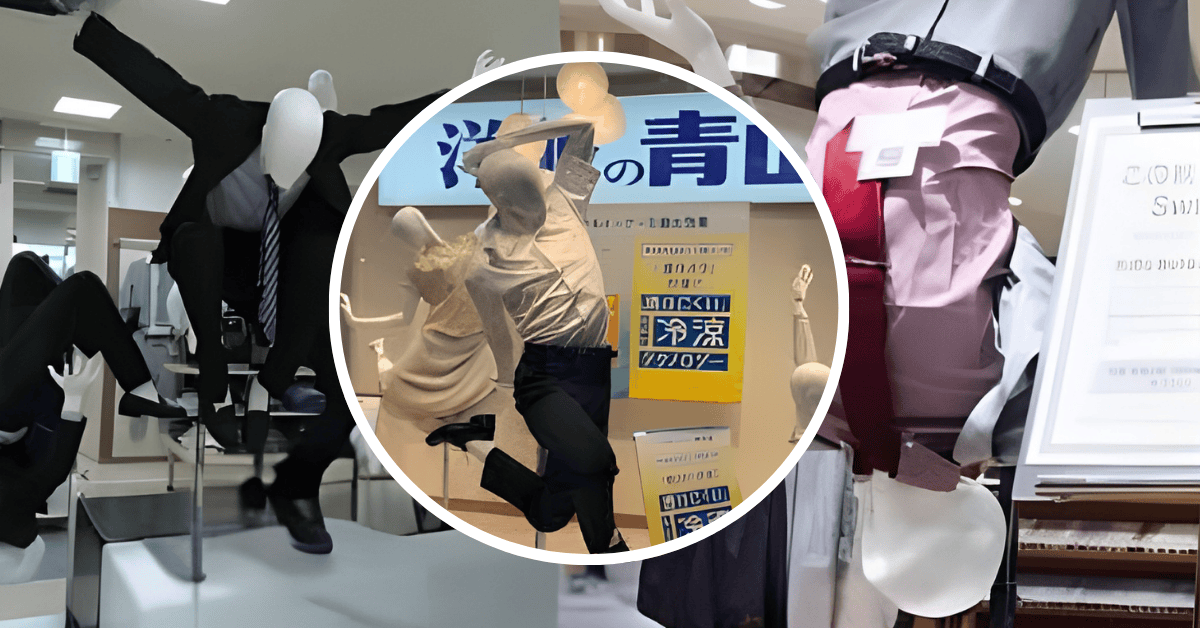
Every pose is a silent product test.
In many Japanese clothing stores, mannequins are no longer passive figures meant only to display color or cut. They are active participants in the sales process. Bent knees, deep squats, wide lunges, twisted torsos, raised arms frozen mid-reach — each pose is chosen with intention. Nothing about them is casual. The mannequin is not standing still because the product is not meant for stillness.
Traditional displays ask customers to imagine how a suit might behave in real life. These displays remove imagination entirely. They replace promises with proof.
A sharply dressed mannequin crouched low to the ground answers questions without language. Will the fabric stretch? Will the seams hold? Will the suit restrict movement or ride up uncomfortably? The answers are visible at a glance. The suit is already being pushed harder than most customers would ever dare to test it themselves inside a store.
This approach does something subtle but powerful: it eliminates hesitation. Shoppers often carry quiet doubts they do not voice. They wonder whether something will tear, wrinkle, pull, or fail them at the wrong moment. Instead of addressing those doubts with tags, slogans, or sales pitches, the display confronts them head-on. The mannequin performs the stress test on behalf of the buyer.
There is also a psychological shift at work. When customers see a suit flexed into extreme positions, they stop viewing it as fragile or formal. It becomes practical. Wearable. Trustworthy. The suit is no longer an object that demands caution, but one that invites confidence. If it can survive that exaggerated pose, it can survive daily life — commuting, sitting, reaching, bending, and moving without constant self-awareness.
The brilliance lies in how quiet the message is. No signs claim “maximum flexibility” or “engineered comfort.” No salesperson needs to explain fabric technology or construction. The display lets reality speak. The customer is free to observe, conclude, and decide on their own. That autonomy strengthens trust.
This design philosophy reflects a broader cultural emphasis on function over flash. Rather than exaggerating benefits through words, it demonstrates them through action. The product is not framed as something to admire from a distance, but something already tested under pressure. The mannequin becomes a stand-in for the customer’s real body and real movements.
In doing so, the store reframes what a display can be. It is not a static presentation. It is a visual argument. A question answered before it is asked.
By the time a customer touches the suit, much of the decision has already been made. Doubt has quietly exited the room. The product has proven itself without speaking.
You don’t need to ask how flexible the suit is.
You don’t need to imagine how it will move.
The answer is already standing right in front of you — bent, stretched, tested, and unafraid.