
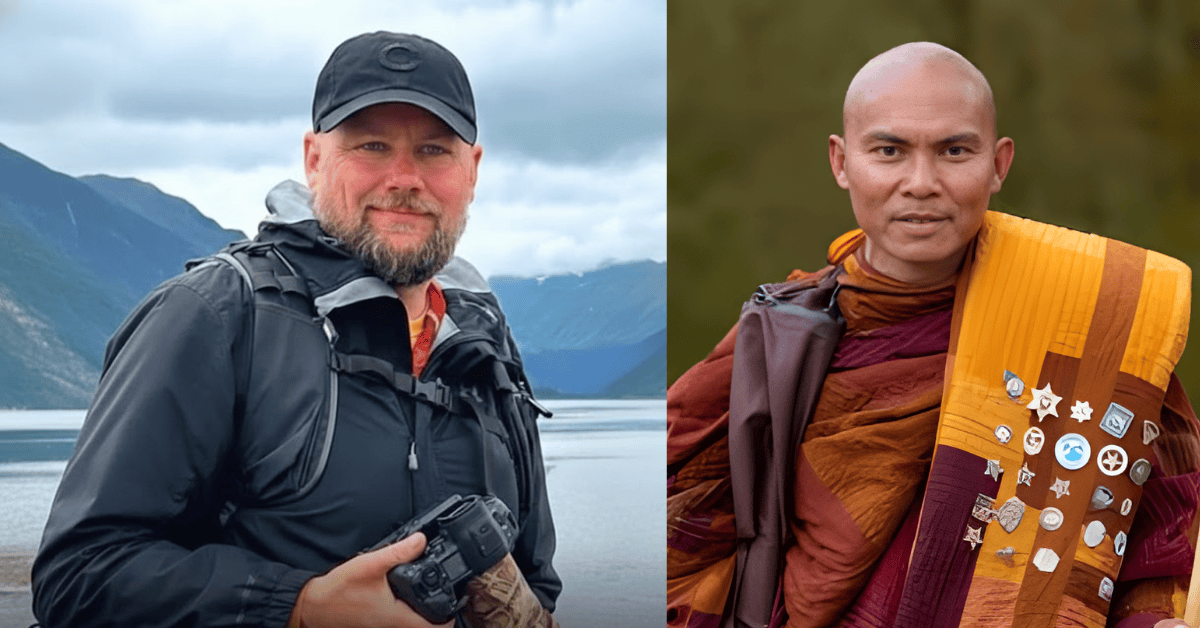
When Alabama photographer Henry Eiland first learned that a group of Buddhist monks were walking more than 2,300 miles across the United States on a Walk for Peace, he felt an immediate pull to witness it himself. The monks were scheduled to pass directly through Alabama, and in December 2025 Henry lifted his camera and followed them through the towns of Auburn and Opelika. What began as professional curiosity slowly turned into a deeply personal experience, one that would gently challenge his assumptions and quietly reshape his understanding of faith, community, and compassion.
The monks moved steadily along highways and small roads, their unhurried pace contrasting sharply with the speed of modern life around them. Henry photographed bare feet touching pavement, hands resting in prayer, and faces shaped by calm determination. Onlookers paused, waved, or joined in silence, creating brief but meaningful connections. As Henry continued documenting the walk, he found himself less focused on capturing striking images and more absorbed in the presence and intention of the journey unfolding beside him.
On December 25, Henry and his wife, Kendra, attended a peace gathering at Foundry Opelika Church, where the monks were welcomed by local residents. Raised in a Pentecostal Christian tradition, Henry was deeply moved by the diversity of the crowd. People of different religions, cultures, and backgrounds stood together in a shared moment of reflection. The gathering felt less like a formal religious service and more like a collective affirmation that peace, kindness, and understanding remain universal human values.
After the gathering, Henry continued following the monks as they crossed into West Point, Georgia. This time, he did more than observe from behind the lens. He walked alongside supporters who joined the monks for portions of the journey, sharing conversations, silence, and simple meals. Along the route, donated food, water, and supplies were distributed not only to the monks, but also to members of nearby communities in need. The walk became a moving act of service, extending compassion beyond symbolism into real, tangible action.
Henry’s photographs eventually reached Dr. Long Si Dong, one of the leaders of the Walk for Peace. Impressed by the sincerity and care evident in the images, Dr. Dong invited Henry to formally take portraits of the monks. The invitation affirmed Henry’s role not just as a documentarian, but as a witness. Through this experience, Henry came to believe that compassion still has the power to unite people, and that peace often begins simply by choosing to walk, watch, and care.
For Henry, the journey lingered long after the monks disappeared down the road. The photographs became reminders of shared humanity and quiet courage. He reflected on how witnessing the walk changed his creative purpose, encouraging patience, humility, and openness. The experience taught him that peace is not abstract or distant, but practiced daily through attention and empathy. Sometimes it begins when ordinary people slow down, listen carefully, and allow compassion to guide their steps together. These lessons remain with him, shaping his work, faith, relationships, and future.